Our bodies are marvellous creations. We would do well to reflect upon that more often, but we don’t. We take them for granted until they go wrong. The SIJ really highlights this – its vital to our very existence but we don’t even know it’s there.
Remember that song from your childhood “dem bones ” ?
View https://www.youtube.com/watch?v=pYb8Wm6-QfA for a really lovely reminder.
the hip bones’s connected to the back bone
So without realising, we’ve all heard of the Sacro-iliac joint (SIJ), but unless you’ve suffered a diagnosed SIJ injury, singing that song was probably the last time you thought about it.
How is it that one of the most fundamental and utterly vital joints in the body could be so unknown to us? My guess, (and it is only a guess) is because it doesn’t move very much – only about 4 degrees of movement. We don’t see it and therefore we don’t give it any consideration..
.. a bit like the spark plugs in a car engine. Without them there would be no combustion and no engine movement, but we give those precious little attention!
Well, I want to try and redress the balance a little, and i’m going to have to start with a bit of anatomy.
The sacrum is a wedge shaped bone comprising the five fused sacral vertebrae. Above it is the lumbar vertebrae and vertebral discs and below it are the fused vertebrae of the coccyx. The sacrum fits into the pelvis which is itself made up of 6 fused bones (3 on each pelvic half – one ilium, one ischium and one pubic bone).
The meeting point of the 2 iliea and the sacrum is the SIJ. Its vital importance to the body stems from the fact that this is where the forces of motion from the legs are transmitted up to the trunk and upper limbs and it is where the spine bones are attached to the bones of the lower body. Like the hip joint (where the femur, or thigh bone meets the pelvis) it has to be tremendously stable and strong whilst allowing for some movement. The SIJ is part of the pelvis and therefore intimately connected with movement and gait.
The design of the joint is also such that it allows for small but very important movements of the pelvis and sacrum:
In SIJ movement known as NUTATION, the sacrum moves forwards and down relative to the pelvis, which also moves. It is in this position that the joint is at its most stable. The already stable “keystone” structure of the pelvic halves surrounding the sacrum is further compressed. The joint is locked (Form Closure) and is like this during load bearing activities of standing and sitting.
However, we don’t just stand and sit. Different behaviour of the joint is required for walking and running when the loading alternates between the legs. The stability here is provided by the muscles, ligaments and fascial links crossing the joint perpendicularly. In this configuration of the joint (Force Closure) the movement is COUNTER NUTATION: the sacrum moves backwards and upwards relative to the pelvis.
As if that wasn’t complicated enough, the two pelvis halves can also move independently of each other.
In many ways though, the complexity doesn’t matter. What matters is that we understand that the pelvis should be stable and mobile. The musculature needs to be strong and supportive but not so grippy and tight that the pelvis cannot move properly. So SIJ problems can arise from too much stiffness in the joint, but also from too much movement (joint hyper mobility).
Symptoms of SIJ Injury
It’s central location and importance means that symptoms can be in different parts of the lower body and be non specific .
The pain can be on the left or right of the lower back and can radiate into the buttocks or in to the groin and even into the testicles in men. If it refers into the lower limb or even the knee then it can be mistaken for sciatica.
The pain can be sharp or a dull ache. A classic symptom can be difficulty turning over in bed or pain getting in and out of the car, lower back stiffness after sitting for long periods or when getting up in the morning. The ligaments surrounding the joint can be tender.
Causes of Injury
For simplicity, the causes of injury can be grouped into 4 categories:
- Biomechanical injury – problems caused the prolonged faulty movement patterns that can arise from a whole host of causes: leg length discrepancy, a tendency to over pronate the foot (where the foot tends to fall inwards), muscle imbalances, poor running technique, having an overly dominant leg, chronic postural problems.
- Hormonal changes – the most common cause is due to pregnancy when secretion of the hormone Relaxin causes increased laxity of all the joints in order to accommodate the growing baby and prepare for child birth. For some women this increased SIJ mobility can disturb the joint and cause pain.
- Inflammatory disease – can disturb the joint and cause problems in much the same way as an osteoarthritic knee joint will be painful and have altered function. With the SIJ the most common disease to cause problems is Ankylosing Spondilitis.
- Traumatic Injury – often caused by falling on the joint or by landing hard on one leg, pulling the ligaments or twisting the pelvis.
Ongoing SIJ problems need intervention. SIJ injury cannot be seen on X ray or an MRI scan. Generally it will be diagnosed on the basis of case history, symptoms, and with a hands on assessment by a Manual Therapist, often an Osteopath, Chiropractor or Physiotherapist.
So Where Does Pilates Come In?
It is particularly useful for people whose problems arise from biomechanical injury. These are the people who need to look at their body alignment, movement patterns, muscle recruitment strategies and the balance between freedom of movement vs stability. In some ways that is all of us, it’s just that only a small proportion of are unlucky enough to end up with SIJ injury.
All of the localised muscles that attach to the pelvis (pelvic floor group, glutes, hamstrings etc) have some kind of role to play in pelvic/SIJ stability and movement and you could probably write an entire book on that subject alone. Given the interconnectedness of the body, the movement, stability, tightness, weakness, injury (and so on) in the foot or shoulder or anywhere else in the body, will impact upon the pelvis, however subtly.
But….. leaving that aside I want to highlight three important muscle systems which stabilise SIJ and which Pilates exercises can target thereby addressing imbalances and weaknesses. Whatever the cause of SIJ injury, it is really important that the muscular forces that provide SIJ stability during force closure are working properly.
Posterior Oblique Muscle Sling

Involves the Latissiums Dorsi muscle (the big muscle in the back) which is connected via connective tissue known as the Thoracocolumbar fascia to the Gluteus Maximus (your buttocks) on the opposite side of the body. This muscle sling stabilises the SIJ and the pelvis in general, especially during walking , running and activities involving spine rotation.
A classic exercise to work this sling would be Swimming, with opposite arms and legs.
Anterior Oblique Sling
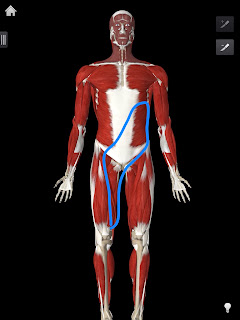
This is a similar stabilising group of muscles, but at the front of the body.
It involves the External Obliques (waistline muscles), and the deeper lying Internal Obliques and Adductors (inner thigh muscles) on the opposite side of the body and stabilises the SIJ and the joint at front of the pelvis where the two pubic bones meet.
Exercises to work this sling would be lying supine with table top legs and then doing knee rolls or alternate knee drops to the side.
Longitudinal Sling

Whilst this sling does not directly act on the SIJ, it does profoundly affect the function and stability of the pelvis during standing and walking.
(Don’t confuse this sling with the similarly named Deep Longitudinal Sling which has a different function!)
Involves the Quadratus Lumborum (a muscles in the lumbar spine) and on the opposite side, the smaller buttock muscles: Gluteus medius and minimus and the Adductors (inner thigh).
You could work this sling in side lying exercises: leg circles, double leg raises, even clam.
Unless you have injury, inflammatory disease or problems as a result of pregnancy, normal SIJ (and pelvis) function doesn’t require constant attention or focus. First and foremost normal SIJ and pelvic function requires us to move properly and herein lies the value of Pilates. When you do regular Pilates, you learn body awareness, correct alignment and the need to relax; you gain functional strength, get used to using the right muscles at the right time, and develop good joint mobility.
This is sounding like a call to arms isn’t it……..So yes, do some Pilates!
To help persuade you, here is some good news : the really valuable stuff, the Pilates that helps you to learn to move better, doesn’t come from doing the glamorous stuff – you know the kind of thing – it’s always featured on the front cover of Pilates DVDs and online, (surprise, surprise), tends to feature young women wearing cropped tops. Learning to move better comes from the small, subtle, beginners type stuff – the kind of thing we can all have a go at.
Why not try a tiny bit, right now?
Go on….
It wont take long…..
The thing is, I reckon you’re probably sitting with a slightly slumped, rounded back. This places unnecessary strain in the lower back, throws the front and back of the body off balance – too long at the back and too short at the front, and disrupts normal breathing.
Gently and lightly reach your spine – so move from the back of your body – upwards. The crown of your head floats higher. Now your the spine is supported underneath via the sit bones. If you’re not sure what they are, check out a previous blog post: The Traffic Queue – a blessing in disguise?
Further support is via the soles of both the feet resting gently but firmly on the floor (or foot rest). So the floor and the legs support the body rather than the thigh muscles gripping to support the body.
Carry on reading, eating, talking, social media-ing but as you do, be aware of breathing into your pelvis.
Let your shoulder blades drop down a little, away from your ears
That’s it! Not so difficult eh?
Darn difficult to remember to do though!
This article is really wonderful. Many, many thanks!!!
I love reading it!!!
Please can you write something similar for the abs and shoulders?
Thank you!!!
hi there Lucilla. Thank you for your kind words Lucilla. Here is one of my blog posts about the shoulders
https://www.pilates-leeds.com/blade-runner-2019-five-things-you-really-need-to-know-about-your-shoulder/
My most recent post is about the abs too. I hope you enjoy them as well, although the ab one is a little controversial
Best wishes Alison x
https://www.pilates-leeds.com/ab-dominance-why-are-we-so-ab-sessed-with-the-abdominals/