Have you been recommended Pilates to help with your back pain?
Has your GP told you to do Pilates for your back pain?
Were you thinking about Pilates as part of your strategy to hep with your back pain?
People often turn to Pilates for back pain but do you really know why?
As it happens there are loads of reasons, but here I’ll outline 5 really big ones.
Improve and optimise your core function into help with your back pain
This may not be what you think it is! Often “core” is taken to mean the abdominal muscles.
Over the years, I have heard “I have a weak core”, many times. People have come to me because they believe this is their problem and the cause of their back pain. I rarely agree with the assumption of “weak core” but optimising the core cylinder is definitely part of the healing process for for some people.
This is how I look at core function through a Pilates lens to help with back pain.

Assess and restore optimal breathing, possibly easing chest, neck and shoulder tension which can feed back pain.
Optimise the breath / core. That is, the synergy of the deep abdominals, the pelvic floor and the diaphragm.
Work on letting go of tension and bracing. This can be hard if you are bracing to generate a sense of safety but we need optimal movement free of excess tension.
Address pelvic floor dysfunction. This is often related to back problem.
Once the Core is optimised, work on core stability exercises and add in exercises to work the superficial abdominal muscles. They need to be functionally strong too.
Core dysfunction may not be the cause of the problem but can be part of the solution
Calm the nervous system so that you feel safe to exercise.
This is useful for everyone and absolutely essential for people with ongoing and significant chronic low back pain, or any ongoing pain problems. When pain has stuck around for ages, you can end up in a “bad place” where lots of movements, daily activities, even the weather, can be triggering.
If this is the case then no exercise will work unless you feel that it is safe.
This approach only really works in a 1 to 1 or very small group setting like my Back Care Pilates courses. The Pilates session has to be organised so that you are in a safe position. Quite literally, your body position needs to be ok and comfortable be that lying, side lying, sitting or semi lying.
Each exercise needs to be slow and gentle so that the nervous system computes that it is safe. The Pilates session is there to give your body a positive movement experience which eventually extends to that movement in daily life feels safe. The Pilates helps your back pain by being the little seed of movement that eventually grows into something bigger.
This clip is rather long but Eric Cobb does a brilliant job of explaining the role of the nervous system in creating, modulating pain.
Use Pilates to help your back pain by mobilising the tight spine.
When people come to my studio with the purpose of using Pilates to help with ongoing lower back pain, a big proportion of those people are managing, but it is very irritating, or the problem keeps on flaring up.
I always consider the following 3 things: get the upper back moving to relieve pressure on the lower back. Next, get the pelvis moving better to relieve pressure in the lower back. Lastly, get the muscles in the pelvis stronger, again for the same reason: to offload pressure and overwork in the lower back.
Firstly I really ought to define “mobilise”. I use this word often, even though it is fitness industry jargon and I should know better!
Joint mobility is the ability of the joints and surrounding tissues to move freely and efficiently through their full range of motion under conscious control.
It is a massively big deal in the spine because there are so many joints! With our sedentary lifestyles, the spine gets stiff through lack of movement. If our muscles weaken, especially, but not entirely with aging, this has a knock on effect of creating stiffness. This is especially true in the mid back, the bit attached to the ribcage, the thoracic spine. Tightness here can cause overwork in the lower back.
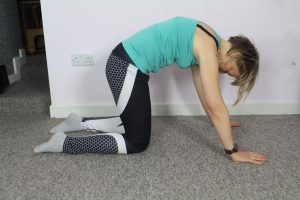
Pictured here is me in the Cat part of Cat/Cow. This is an all fours exercise designed to get segmental movement in the spine in forward bending and back bending. Pilates has borrowed this from Yoga, and much else besides because so much of Yoga is beneficial.
The aim of Pilates here is to redistribute load throughout the spine and away from overwork in one or two places in the spine.
Pilates is just brilliant at addressing tight spine issues. Within Pilates there is a big toolkit of exercises aimed at gently mobilising the thoracic spine.
Similarly, use Pilates to help your back pain by mobilising the tight pelvis.
We are back to our old friend, the sedentary lifestyle. It is a driver of tightness in the pelvis. Too much time sitting or driving (and sadly for me, cycling,) causes the pelvis to stiffen. You might be asking , “so what?”. Well the body has to move and it will find a way of getting us from A to B but you can end up with over moving in one place and under moving in another. Nothing is ever 100% certain, but if you have lower back pain, consider tightness in the pelvis as a possible cause.
The typical example of how a tight pelvis shows up in daily life, would be sitting into a chair, or going into a squat position by rounding the back instead of pivoting through the hip joint. The lower back is is rounding because there isn’t enough “give” at the hips. This is chronic overwork of the spine and for some people, over time, can cause back pain.

Pictured above is me doing a supported Psoas release. The Psoas is one of the muscles in the front of the hips which can get very tight with prolonged sitting.
Work on strength in the hips/pelvis to off load the spine.
This dovetails with getting the pelvis/hips moving more. Not just more mobility but more strength.
If you have back pain then increased strength in the back of the legs, the bottom, the front of the thighs can be vital in helping you to become pain free. Again there is a dedicated repertoire of Pilates exercsie to help with this. Crucially, they can start gentle and so that you can have a go, despite pain and despite a lacking strength for more famous or obvious exercises like Lunges.
Time after time I’ve met people who have been given strength exercises to help their pain but who cannot do the exercises or they made the pain worse. This can include Pilates exercises. In other words the exercise is aimed at strength but you lack the strength to do the exercises.
In my studio, using Pilates to help back pain, I can strip down the exercises, to reach a level where they are do-able or substitute a hard exercsie for an easier one that has the same goal. Ideally we can increase the exercise intensity over time.

The picture above shows 2 people doing Glute Bridge in my studio. This exercise is a firm favourite for easing back issues. It can be gentle, it requires pelvic and spine mobility but it also improves those things, and in addition it can develop strength too. It is a good example of a Pilates exercise that can be so helpful for back pain. Glute Bridges are so good, I wrote an entire blog post about just this one exercise and you can read that here.
Do you think Pilates might be helpful to help your back pain?
Please do get in touch here or just comment on this blog.
There is more detail on the website about the Back Care Pilates courses . The course are on an evening and morning. Alternatively I offer 1 to 1 Pilates.
If you prefer to stick with group classes, that is definitely feasible too. There is less focus on exactly what you specifically might need need, but provided you chose a beginners class then you have the security of knowing it will be fairly low intensity and still be full of Pilates goodness.
Hi Allison
Looking forward to getting back to our weekly classes .Not easy dealing with cancer and it’s side effects by myself ..Hope that we can conquer back pains and muscle weakness and keep progressing .Thank you so much for your support !
Jonathan I am sure that we can. We just need to keep going, and perhaps, errrrr, never go on holiday….???!