I’ve written “the” traffic queue, not “a” traffic queue, which confidently assumes that there will be a queue. Queues are part of life and generally viewed negatively but could they have a good side? Maybe not always but we can make better use of our queuing time, and, without needing a smart phone, Sudoku or even, when things get a bit desperate, i-spy? That is, i-spy, the childhood game of our pre digital era, not some kind of new web browser from Apple!
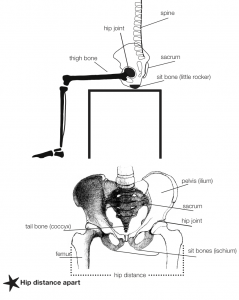
The thing about a traffic jam is that you are sitting down, thus making it a great opportunity to concentrate on seated posture. We spend large amounts of our day sitting. This is not so good for the spine, it de-conditions the big muscles in the bottom and the back of the legs, and it over tightens the big muscles at the front of the legs. Why not try this:
Have your feet flat on the floor (so off with the high heels) and sit on your sit bones. If you feel through the flesh of your bottom, your sit bones are the palpable bony bits of the pelvis that stick out and down. Their colloquial name is a good one: you really should sit on the sit bones. Achieve this by gently reaching up from the back of the pelvis rather than pulling up from the front of your body. If, like most people, you sit on the fleshy part of your bottom, sitting up on your sit bones will make your pelvis and bottom reach upwards and help your spine to straighten and lengthen (because it is no longer so rounded). Your sit bones are a vitally important base of support in sitting and the other one is your feet. Relax your feet and your legs. If you’re not driving, allow the soles of your feet to reach into the floor and relax the front of your thighs. This can take a bit of doing because we barely notice the tension in our thighs. If you are sitting upright, imagine that tension is flowing away from the thighs, over the knees and down and away from the legs. If you’re in a seat that means your knees are higher than your hips, then it might be more effective to think of the thigh muscles relaxing and melting towards the hips.
Now consider your collar bones and shoulder blades. Are your shoulder blades tense and elevated? Let them melt away from your ears, as if they hang, like a cloak, from the back of your ribs. Very gently, create distance between your shoulders and your ears – there should be length in the neck (front and back) as well as lower down the spine. You have created length in your body (with the spine), but width is important as well. Allow your chest muscles to soften and imagine that your collar bones could widen, almost as if they were to reach through the tops of your arms. Keep it gentle. This is not something you can do wrong, but it’s possible to overdo it. We want the muscles to do less work, not more.
The next thing is mainly for drivers. Take note of how you are holding the steering wheel. Are you gripping it? A traffic queue, and indeed driving in general is not a white knuckle ride. Although here speaks somebody who has never driven in London….. Relax the hands. It isn’t just the steering wheel either. What about your phone, Children’s hands, the handbag? Losing a bit of this largely unseen tension could have a tangible effect on the state of your shoulders.
Rather arbitrarily, that’s four bits of the body: thighs, chest and shoulders, hands, spine. What I’ve suggested needs a calm and calming focus on the body. How often do we listen to our body – notice where it is in space? Or take account of how it feels? By that I don’t mean “how am I feeling?” What I mean is “how does my body feel?” When was the last time you asked yourself that? We spend most of our day “in” our heads and precious little of it “in” our bodies but focussing on the body is hugely valuable, not least because it has a slightly meditative quality. Our bodies are finely tuned machines and we want to keep them that way. Ideally we make an effort with diet, exercise, hydration, sleep, relaxing and socialising but also we need to pay attention. Our bodies will tell us things – take notice! Oh, and watch the road as well…..
Photo credit Rosalind Ferry
Great for the waiting room at the doctors or even the hairdressers.
Great advice Alison – I like the article – so important as you say to spend time ‘in’ your body…