In July 2023 I unexpectedly received an Osteoporosis diagnosis. I didn’t see that one coming.
Prior to that I launched an exercise class for people with Osteoporosis or Osteopenia.
I thought it would be interesting to see what my bone density and body composition was, so I had a DEXA scan done privately.
The DEXA scan is used for bone health assessment and subsequent osteoporosis diagnosis. Your spine and thigh bones are assessed, not the whole body. It is quick and non invasive and the NHS gives more detail here.
This real irony. I launched the class then found out I actually had osteoporosis myself.
Getting used to my Osteoporosis diagnosis
Well, it was a shock. I am well past the age of feeling invincible and well into the age of bits and pieces going wrong: IBS (with more on that story, from me, here), Tinnitus, Raynaud’s, Lichen Sclerosis. I’m years post menopause which puts me at risk for a range of chronic health conditions, like heart disease, but I definitely didn’t expect this. But then, Osteoporosis is not called a silent disease for fun it it?
I don’t like thinking of it as a disease I find that quite scary. Instead I prefer to think of it as a condition that is happening to me and my bones. In fact I have borrowed the word condition from the Royal Osteoporosis Society website’s homepage here.
Osteoporosis is generally viewed quite negatively, because the consequences of it, that is broken bones, can be extremely serious, and life changing. I’m trying not to think of that either! I’m extremely fortunate to have been diagnosed early whilst still fit and healthy and thus in a very good position to do something about it. Most people only receive their diagnosis after they break a bone as some of you will know only too well.
There I was, setting out to help other people with my exercise class and I’ve ended up helping myself as well.
How come I’ve got an Osteoporosis diagnosis?
There are loads of risk factors for Osteoporosis and I have a few of them. For starters I am over 50, years post menopause and not on HRT.
I have a family history of Osteoporosis. Without doubt my mother has it and both my maternal grandparents died after falls which led to fractured thigh bones.
I wasn’t a sporty child. Indeed I have never been sporty, and crucially not in my 20s. This resulted in my peak bone mass, at that time, being less than it might have been. Here is a quick definition of peak bone mass, In short, the maximum density your bones can achieve, in your early 20s.
Less significantly, but not irrelevant, I have a 20 year history of significant dietary restriction due to my IBS.
I have only got Osteoporosis in my spine. I have Osteopenia in my thigh bones and that is possibly due to a 25 year on/off habit of running and 16 year history of teaching high impact aerobics. Given the osteoporosis diagnosis, I am concerned that now I do far less high impact exercise than I used to, the condition will progress in my thigh bones.
How my GPs have helped me
I was prescribed the first line treatment for the condition which is a weekly tablet from a class of drugs called the Bisphosphonates.
I was not offered HRT. This helps to stabilise the bone loss by supplying you with the now missing Oestrogen. My GP told me told that HRT is only given for the symptoms of the menopause, like night sweats, brain fog etc. I think this is incorrect and in direct contradiction to what friends of mine have been told and also what the medication advice on the ROS website is. On the other hand, perhaps the Bisphosphonates are a better option for me given that I wasn’t on HRT beforehand. Nobody explained the rationale or what might be best for me. At the time I didn’t even consider that I might have a choice.
I was invited for a blood test for Calcium and Vitamin D. My Calcium levels were within normal limits and my vitamin D level was dreadfully low. A course of high dose Cholecalciferol aka Vitamin D was prescribed and that brought my levels back to normal limits. I had been really fearful that somehow I had “caused” my Osteoporosis by a nearly 40 year avoidance of meat and fish and was so relieved that only Vitamin D was off.
Post blood test I was seen by a second GP and I asked about lifestyle changes and exercise. I was told “You are a Pilates instructor so you know what to do“. I resisted the temptation to point out that if I knew what to do, how come I’ve got an Osteoporosis diagnosis. Plus, much as I hate to say it, Pilates is definitely not the solution for an Osteoporosis diagnosis.
What else did I do?
Strength training
To impact bone density you need to lift heavy weights. The resistance needs to be as heavy as you can manage, so I’ve raised my game at the gym. I am exceedingly fortunate to be a gym instructor and a regular gym goer so I’ve doubled my visits to twice weekly and focused more on heavy lifting in particular exercises.
Slightly haphazardly, this is my weekly regime
Deadlift, now up to 50 kg.
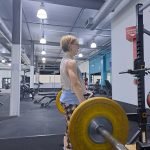
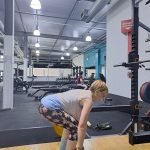
Back Squat. Don’t get me started on this one! I am really struggling. It is not the weight, it is the flexibility required to support the bar on my back that I’m struggling with. I need to do loads of self massage and tissue release work first. And I haven’t. I can manage a 7 kg body bar but aim to significantly increase this. (Shown in the video clip)
Bench Press, now up to 25 kg.
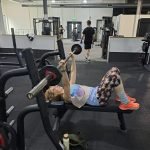
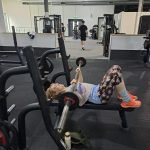
Press Ups are a definite struggle. I am still only on 5 small ones but with good technique.
Pull Ups, I’m getting there, slowly and it’s not pretty. So far I can do 1 with a thin band to assist and half of one on my own.
Dead Hang, I can manage 1 minute so far. Not pictured or in the video but basically you hand from a bar with an overhead hands position
This short video is me doing pull ups, plyometric jumping, press ups and back squat. I’m a bit iffy with my technique, and my pull up is not yet a full repetition but this is work in progress.
Spine alignment and mobility
This is very much where the Pilates comes in. To reduce the likelihood of vertebral (the individual bones of the spine) fractures I aim to keep the spine well aligned and moving well. If the spine becomes stiff or misaligned, and the most common iteration of this is age related curvature of the upper back, then the chance that the vertebrae will break spontaneously, goes up.
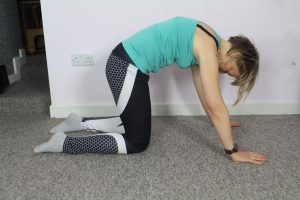
I do regular Pilates exercises to keep the spine moving in all planes of movement, that is forwards and back bending, side bending and rotation. Even better is to do exercises that move the spine in 2 planes simultaneously. For example, side sitting and rotating plus side bending the spine. Or hip hinge with trunk and shoulder rotation and forward bend.
Running and plyometric jumping
Thigh bones are stimulated to stay strong by jumping and running. I dutifully, but not cheerfully, run to the gym once a week to achieve some regular running. I walk a bit and cycle, but the latter is pointless for bone density, sadly. A super efficient way of load the bones is to jump up and down from a step or box. That is plyometric jumping. “Just” jumping is good too but I wanted to make life harder for my thigh bones so I use an old step aerobics step. So far I’m at 1 minute of jumping, twice per week.
Misinformation that has come my way
Bisphosphonates and Teeth
There is a very rare risk of taking bisphosphonate drugs like Alendronic Acid. It is sounds awful: Osteonecrosis of the jaw.
This is a rare complication of dental treatment. The bisphosphonates don’t damage the teeth or the jaw. What they do is potentially cause a failure to heal, post treatment.
Risk is reduced if you are taking Bisphosphonates for Osteoporosis and not for Bone Cancer. Risk is reduced further if you have been having bisphosphonates for less than 5 years, if you take the tablet orally not via an infusion.
If you speak to people with Osteoporosis you’d think that the teeth issue was commonplace. It is not, but the misinformation around the drugs is. To put it bluntly, people like me are far more likely to fall and break a bone then we are likely to get osteonecrosis of the jaw. For me, avoiding medication to avoid that complication is too risky. Broken bones are far more likely.
HRT vs Bisphosphonates
I wasn’t given a choice. Is there a protocol? Is being told no to HRT wrong? I wish I knew.
Bones, teeth and diary foods
A great deal of digital ink is spilled informing us of the need for diary products for lots of nutrients and especially Calcium. I don’t know what to do for the best. I eat cheese but no milk, no yoghurt. If I could tolerate plant based protein I’d be vegan. Am I harming myself? I really don’t know what to do for the best, but I am left thinking – if dairy is so vital and so useful, how come so many people have Osteoporosis? Personally I think strength training is just as important, especially for children and young adults. You can drink all the milk in the world but you need to load the bones to get peak bone mass.
Dietary supplements
I have found it very hard to decide what to do for the best with food and supplements. I am currently taking a Vitamin D / Calcium tablet but to be perfectly honest, I’m not sure why! The latest research suggests that supplementation does not reduce the risk of bone fracture, and that is, after all, the point of all of this. It is not the Osteoporosis that is the problem, it is the outcome: the broken bones.
I am not taking any other supplements for the Osteoporosis, again, because I simply don’t know what to do for the best. The world of supplements is a total minefield and I want to know that something is proven to work before I take it. I’ve read that Magnesium and Potassium are important but another issue is, supposing my levels are ok and I don’t need supplements anyway?
I would ideally like to increase my protein consumption because I’m actively trying to increase my muscle mass. You can’t impact bone density without increasing muscle strength. Muscle strength comes first in fact. My diet is low in protein. I’m intolerant to most vegan sources of protein and most nuts and I choose to eat no meat, no fish, no milk, and very few eggs. I do eat cheese. I have tried protein powders and cannot tolerate any of them. The latest experiment is amino acid capsules and I’m another try with Tofu.
Regular Yoga and Pilates are all you need to help prevent an Osteoporosis diagnosis
I’ve heard this narrative quite often, along the lines of “I do regular yoga so I’ll be fine”. All regular strength exercise is valuable and will help to prevent Osteoporosis and fractures. I think Pilates and Yoga are excellent to keep the spine supple, mobile, well aligned. Both will help you to stay strong too, but with Osteoporosis we need more load, more weight, go heavier.
I am a Pilates instructor and can talk endlessly about the benefits of Pilates, if given the chance! However with the management of Osteoporosis, if possible, use weight above and beyond body weight. You can use Pilates to help with Osteoporosis but in a modified form and I’ve talked about that in a blog post from last year.
When people with an Osteoporosis diagnosis come to my studio for 1;1 I use a blend of Pilates exercises together with more overt strength training with a Pilateasy twist. I largely avoid the lying down spine curling exercises. They might be the most famous ones, but they are also the least helpful if you have Osteoporosis or Osteopenia.
“I don’t exercise but I walk a lot for my Osteoporosis”
Walking is great. It is a real panacea and all round aid to health. Just some of the benefits are that it is is safe movement, attemptable by most people, is good for the heart, helps to maintain an element of strength and helps to keep balance good. However to load the bones and help bone density you need to more than walking. Even in small doses, skipping, jogging on the spot are beneficial and I use those moves in my Osteoporosis class.
My worries
My main anxiety is cycling. I am at risk of spinal fractures if I fall off my bike, or, more likely, get knocked off. I try not to think about it because if I did, I’d probably not cycle any more, well not road biking anyway.
Away from the bike I’m don’t think too much about falling because I don’t perceive myself to be particularly at risk of falls. Just like anyone else, I could have an accident at any point and I push that from my mind because there is nothing I can do about it.
Unless I’m writing about worries, like now, I don’t really dwell on the diagnosis. I stay focussed on my strength goals and diet etc. It would be a different story if I had broken a bone. I am due a repeat DEXA scan in one year and if there has not been any improvement, then I’ll be worried.
Hopes for the future
Basically I want to have no broken bones and to reverse my osteoporosis diagnosis, at least back to the category of Osteopenia.
Can I actually do this? I don’t know but I’m focused on that goal!
My strange new situation is one where I can spread the word and teach the exercises to help other people. One positive from all of this is that I can talk (endlessly!) about posture, alignment, how to do your activities of daily living in a spine safe way and all these other things, whilst speaking from experience. I always have care about my work but this time it is personal.
I teach a weekly EXERCISE FOR OSTOPOROSIS class, with more details here.
Hi Alison, I have 6 monthly Denusomab injections. Recently thought I might need some dental surgery and was told by Oral Surgeon about the risk of osteonerosis and was quite worried. Fortunately the dental problem has improved and surgeon happy for me to leave it.
Will using resistance bands help with increasing bone density and What exercises can u suggest I do at home .
Thanks
hi there Denise. I have a client who is due to have dental treatment and her OP treatment is being delayed until after her teeth are sorted. It does seem to be the dentists are taking it seriously. I have a series of 3 YouTube clips that go together as a kind of home workout Denise. I’m not sure if I can send them here so I’ll email you the links! watching them would be far easier than me trying to describe the exercises too you. Regarding the resistance bands it depends upon how strong the bands are and how much force you can generate. With all strength work to increase bone density you need to go as heavy as you can, whilst staying safe and well aligned. Once you’ve cracked that then it is a case of progressively working harder and harder, which in some ways is the hardest thing of all to do: to keep overloading. did you mean bands to work your legs or your arms/shoulders?
Found this really interesting and informative ,raises an interesting question re HRT….Thank you 😊
Indeed, Adele. would be better on HRT “just in case”. To add to the mix there was something about new meds for brittle bone disease in the news today. I need to listen to a bulletin to see what it is though!
Interesting and informative! Enjoyed reading this ..Thank you .😊
Hello, thank you ! I enjoyed reading this. I am 49 and been diagnosed with -2.7 in lumbar spine so about to start alendronic and calcium/ vit d and I’ve asked about hrt for next year. I’ve been on levothyroxine for 20 years so is the main cause. I’m ironically 90% the way through mat pilates teacher training and reading your experience is interesting as I can relate. I was a dancer in my youth and a junior national swimmer. I’m quite conflicted between deciding on the balance between remaining flexible and strength training but also not loading the bones and over flexing. I’ve also started eating prunes which apparently are a super food for bone creation and slowing loss. I read somewhere that weights need to be less than 9kg? It’s all new to me so any advice is welcome.
Dear Tamsin, it is interesting that you are asking about HRT. My GP has said I am not allowed to have HRT because it is “only given for the symptoms of Menopause”. I think my osteoporosis is partly an outcome of menopause and believe HrT would be protective of further bone loss but I guess I am a few years too early. I am sure the guidance will change. Luckily I can tolerate the Alendronic Acid although it does give me dizzy spells.
I would very strongly recommend that you do as much strength training as you possibly can. I don’t believe that there needs to be a balance between flexibility and strength. Being strong does not make you inflexible, being sedentary, not doing mobility work, and perhaps the menopause might though. Surely Joseph Pilates, of all people teaches us that!! I do think that the excessive focus on flexion in matwork Pilates is super unhelpful for people like us though.
I would dispute the 9kg thing too. That sounds really iffy to me. Call me cynical but stay away from alternative health advice when it comes to Osteoporosis. Mind you, my GP didn’t exactly help me did she?
I would doubt there is any thing close to an evidence base for the 9kg thing. You need to safely lift the most you can possibly safely tolerate. It might be worth you reading my blog about back strength which I’ll link here:
https://www.pilates-leeds.com/spine-safe-movement-with-osteoporosis-dos-donts-maybes/
The back is hard to reach directly and basically you need to load the body to load the spine and aim for deadlifts/back squats, that kind of thing, but perhaps starting with something more gentle. I have the enormous advantage of being a gym instructor as well as Pilates person so I’ve been able to go to the gym and know what to do.
The really classic study on bones and lifting is called the LiftMor trial . Google it ! It was groundbreaking. It is a shame you are not in Leeds. I presume you aren’t? If you were I’d show you some good exercises, Tamsin.
interesting bone density orientated podcast https://movementlogictutorials.com/category/bone-density/
They do go on a bit but in a good way
I’ll leave you alone now Tamsin!