Glute Bridge might not be everything, but it is everywhere all at once.
There is no escape from Glute Bridge in the fitness world, which is great if you love ’em, but do you know why you are doing them? Do you know the purpose of Glute Bridge? Their ubiquity is rotten if you find them hard, uncomfortable or pointless. There is no escape!
You might have been asked to do Glute Bridge by a Physio, an Osteopath or Chiropractor. You might have done them in Pilates, in Yoga or other group ex classes. Personal Trainers like them too.
My aim here is firstly to outline the purpose of Glute Bridge so that you know why you are doing them. Secondly, to explain why they might be a challenge and not quite as easy as you expected. If you dislike them then my final aim is to persuade you to like them by making them more achievable.
Here goes, but first:
A word on names.
Sometimes Glute bridge is called Shoulder Bridge or Pelvic Thrust.
So, what it the purpose of Glute Bridge?
One of the reasons they are misunderstood is because the exercise has 2 distinct aspects to it.
The journey and the destination are related but different, and in Yoga it is a whole other story.
The Journey
In a classic Bridge, the journey is essentially one of sequential spine movement. You rotate the pelvis into the floor, thus rounding outwards your lower back. Next you lift the spine bit by bit into the air. The spine should outwardly curve as you move. Bridge at this point should be fairly gentle with the spine as the focus, although you are standing into the feet to get lift using your leg muscles. The outwardly curving shape of the spine is known as flexion.
The Destination
Once you have sequentially lifted the spine, you reach the more overtly strength element of the exercise. Here you are using the upper back leg muscles (the hamstrings) and the buttock muscles (the gluteal muscles) to achieve and sustain the last bit of lift in the pelvis. At this point you might hold the position. You might lift one heel, one foot or one leg to make it harder.
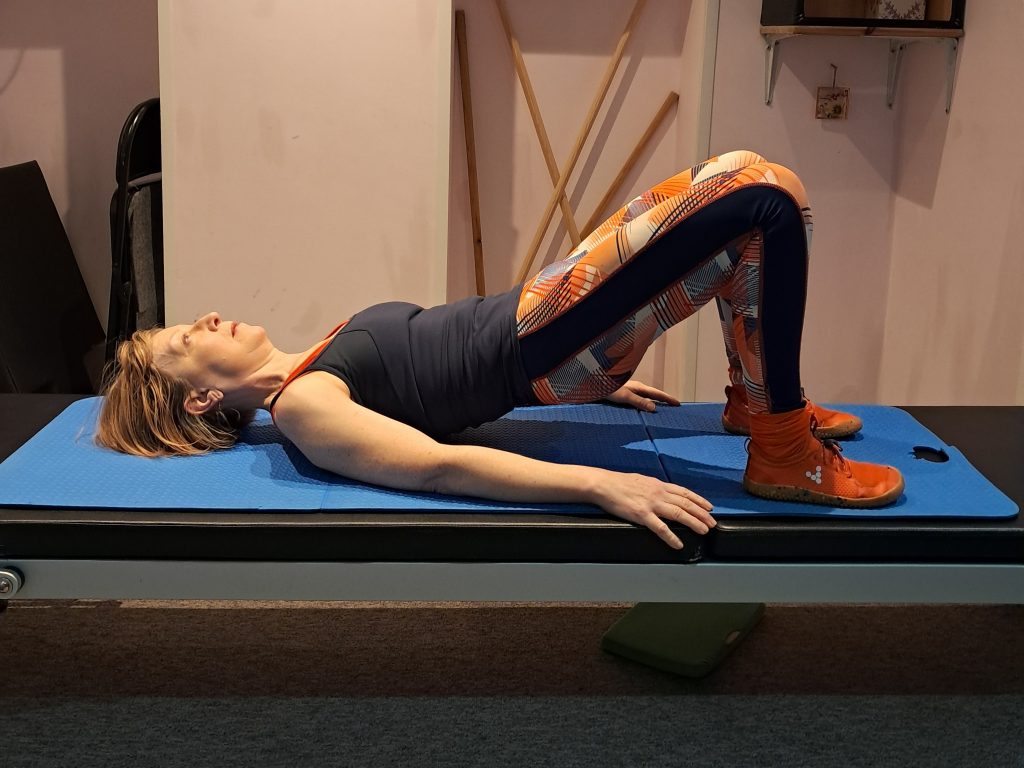
Full Glute Bridge

Half Bridge or partial bridge
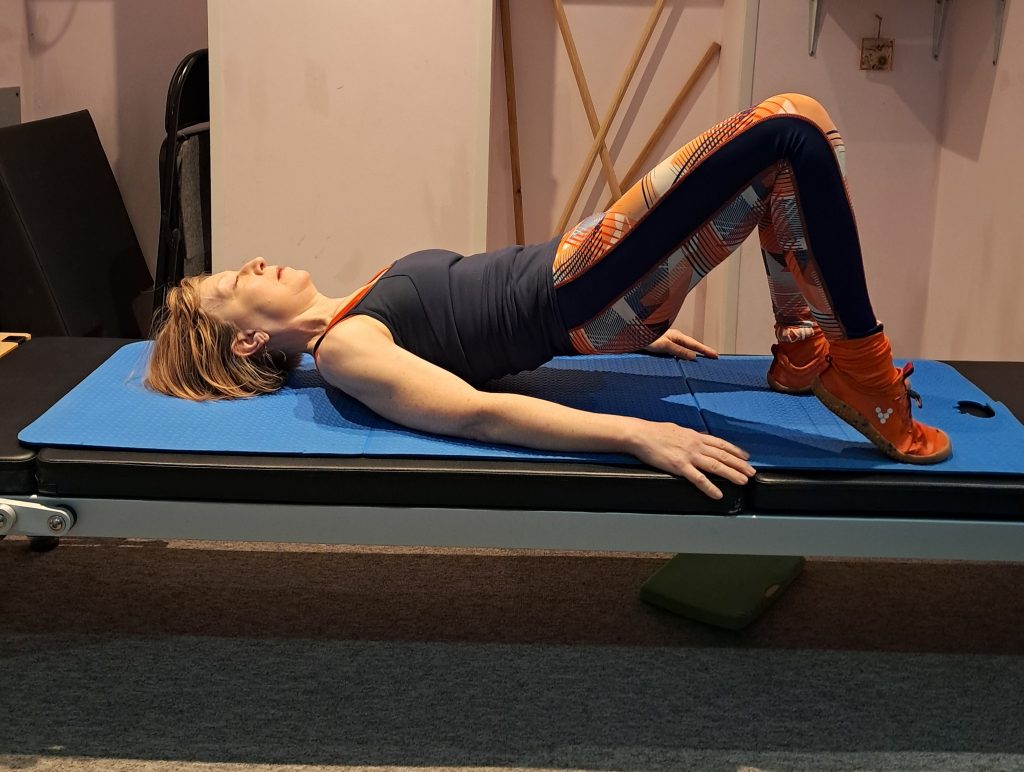
Glute Bridge with foot lift

Glute Bridge with leg lift
Not in Yoga though. The purpose of Glute Bridge is different here.
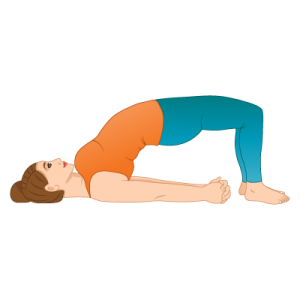
In Yoga the purpose of Glute Bridge is different and more often, is called Shoulder Bridge or Setu Bandhasana.
In Yoga you are aiming to curve the spine inwards on itself, or put more simply, back bend. I think the name “Bridge” makes much more sense if you doing a yoga Bridge pose and it makes you more aware of being supported by the shoulder blades which point downwards whilst the spine is extending upwards.
This is the first layer of confusion, especially if you come from a background of doing Yoga. Check what is the intended purpose of your Glute Bridge if you know Yoga but are in a Pilates class.
In Yoga the purpose is back extension (back bends) with the movement evenly distributed through the spine (which is the super hard bit). That is in combination with leg strength. You still have to use the legs very powerfully. There is more detail about this Yoga pose on this Yoga website .
Why do therapists and exercise instructors love Glute Bridge so much?
- It is a good way of developing leg strength, especially if you struggle with squats or other standing leg strength work.
- Bridge works brilliantly as part of a mat routine as the “go to ” buttock strength exercise.
- It lends itself brilliantly to being made both easier and harder. It is endlessly variable and crops up in Reformer Pilates, with other Pilates equipment and with barbells in the gym.
All of these reasons relate to one thing above all else: leg and buttock strength. The thing almost everyone needs more of.
Yoga aside here, the spine articulation as an outward curve aspect of Bridge is more of a bonus than the main purpose. Having said that, I teach gentle partial Bridges for just that reason. Here, the Half Bridge is a gentle pelvis tilt followed by a sequential lift of the lower back and base of the ribs at the back.
The other thing you need to know to truly get the purpose of Glute Bridge: Hip Extension vs Spine Extension
In plain English: opening the hips and working the buttock/thighs as opposed to opening the lower back, arching it inwards and working the back muscles.
Leaving Yoga aside once more, the purpose of Glute Bridge is to use the buttocks/hips and not the spine. This is also the case with Deadlifts (pictured below with a weighted bar), upper body strength training, most all fours exercises in Pilates, most side lying exercises in Pilates.
It is a very helpful to understand this difference. Certainly for Glute Bridge but for strength training in general. The thing that most often goes wrong in Glute Bridge is that people their back muscles and not their bottoms.
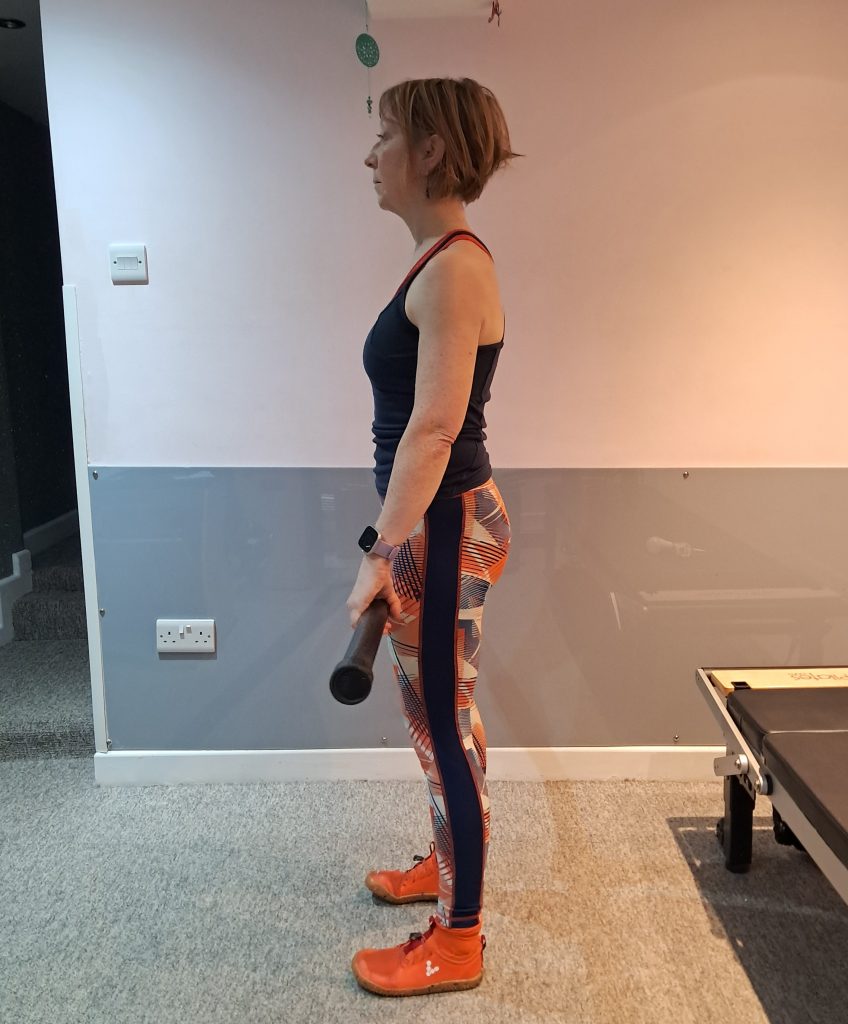
Standing with an ideal spine alignment and open hips, known as Hip Extension. The work to support the weight of the barbell is in the big muscles of the legs and buttocks.

In this pic, the work to support the weight of the barbell is in the lower back and not the legs and bottom. This spinal position is known as Spine Extension
What goes wrong with Glute Bridges?
One important reason is that the people asking you to do it, might know the purpose of Glute Bridge but haven’t thought through how it works in your body.
We instructors need to start observing how the exercise is performed and ask: “Can this person do Bridge properly? Will it achieve the desired ends?”
Just because an exercise is ubiquitous or famous doesn’t make it easy. Even if it is obvious in your head, not least because you’ve seen pictures, it does not follow that it will be obvious in your body. This applies to the person who has asked you to do Glute Bridge, and it applies to you doing the exercise too.
This is a really important point. If an exercise is commonplace, often the assumption is that it is obvious and easy. We assume the purpose is clear, how to do the exercise is obvious and doing it is easy. However, if you then struggle when performing the exercise, that can lead to a sense of failure. However, perhaps the problem is not you at all. Perhaps it is how the exercise choice, framed, and taught that is the problem.
Half the time the pictures online aren’t even correct. There is a lot of blurring of the yoga vs non yoga lines here. And the extreme versions of Glute Bridge tend to come up in searches. One leg Bridge, Bridge with a Fit Ball, or weights, or bands. Honestly, don’t try this at home Save it for AI generated pictures of vacuous looking Stepford Wives in a Pilates gleaming studio.
Tight shoulders / tight chest
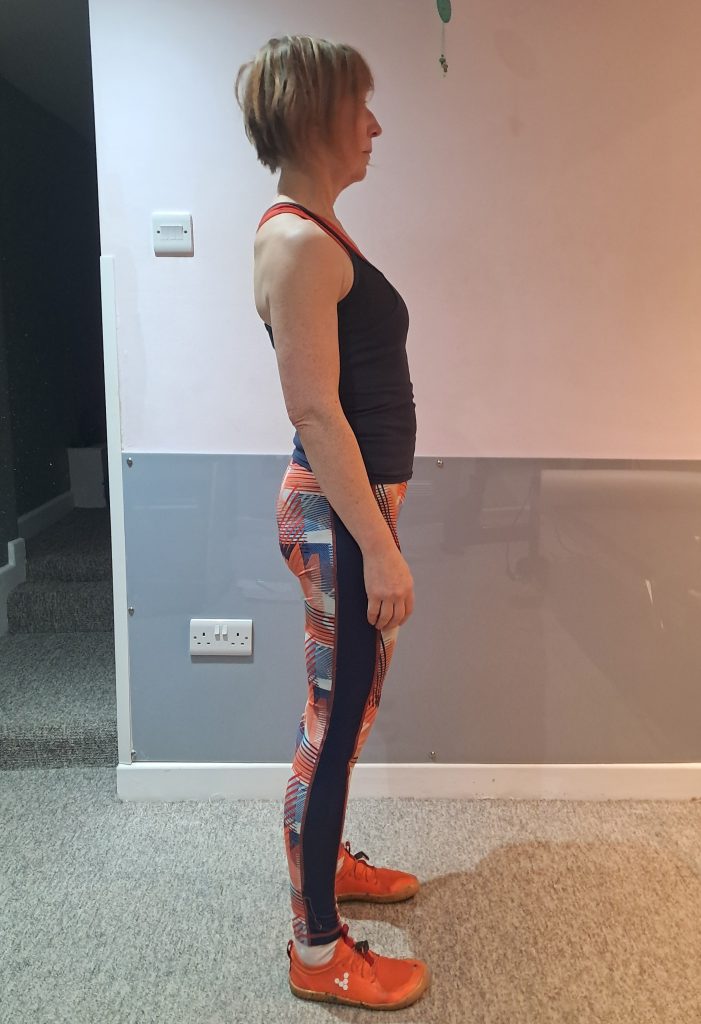
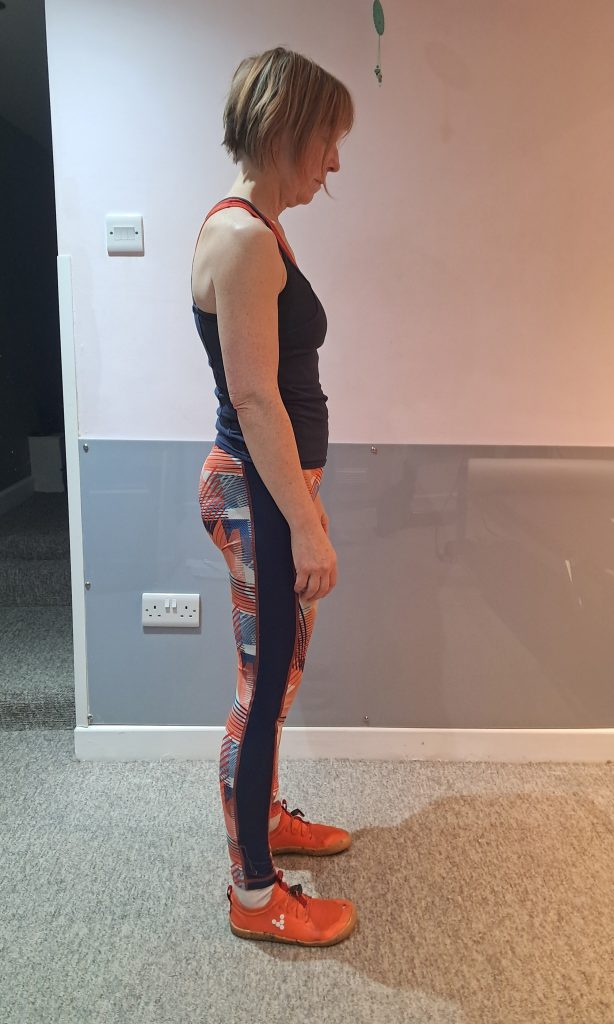
If you have either of these postures, even though they look very different, they tend to translate into this on the floor. (pic below)
On the left, a sway back posture, on the right, your classic head /shoulders rounded posture.
With my apologies for the slightly exaggerated poses and my weird out-of-the way arm
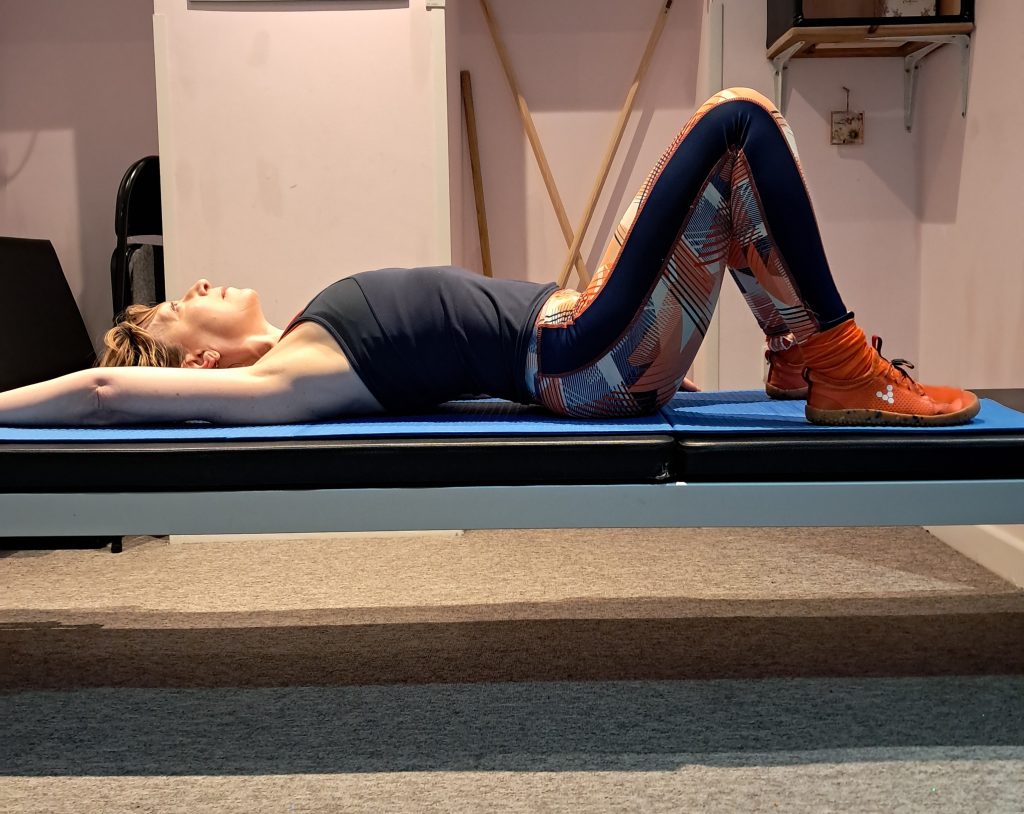
If you have a tight chest and shoulder area or a head forwards position, it can present like this when you lie on your back: the spine is excessively rounded.
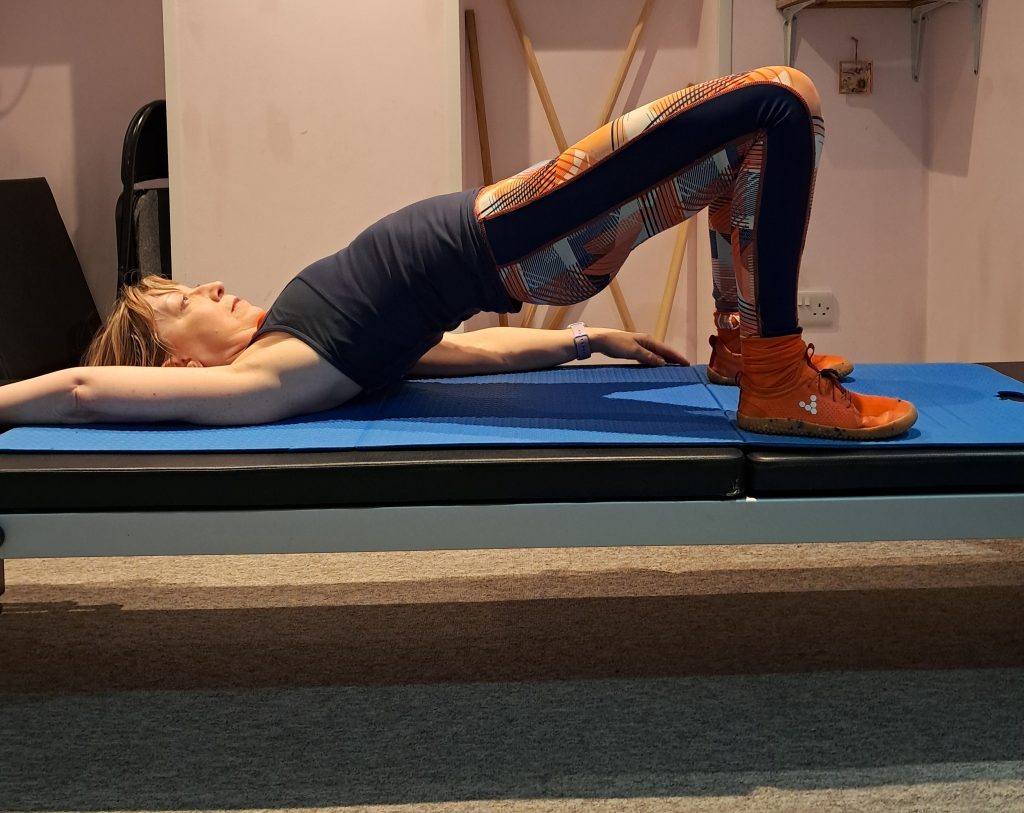
If you start off with too much spine extension, you end up with a Glute Bridge with too much spine extension
Tight hips
By that I mean tight at the front of the legs.
This is a major disrupter of Glute Bridge. We are sedentary lot and we’ve got ourselves into a situation where the front hips are super tight and resist the open position needed for Glute Bridge.
If that is you (and me incidentally) then you bypass the hips and the glutes of Glute Bridge and thrust the spine and lower back up instead. If that is you, you also may not really feel the buttocks and back legs and also wonder why your belly always makes an unwanted appearance in the exercise.
Solution: Shoulder bridge with your feet up the wall, or with your feet on yoga bricks; Perhaps make time to stretch the hips first.


Hamstring cramps.
This is not unique to Glute Bridge but often happens when doing them. The poor old hamstring are often desperately trying to overwork to compensate for absent or weak glutes . Or they are trying to bypass uber tight thighs.
Solution: What ever the reason for the cramping, stop. Your muscles need to calm down.
Being told to squeeze the glutes, brace the abs.
If you squeeze your glutes when you commence the exercise you won’t be able to move. Save that for the very end range. If you brace your abdominals or “engage your core” you will disrupt the natural spine articulation from taking place and strangle the exercise at birth so to speak.
Solution: Do not do either of those things. Breathe normally and allow your abdominals to contract very gently, as part of the exercise. Feel the gluteal muscles start to work naturally during the exercise and particularly at the end. The end point is where you should feel your glutes squeeze up.
The tendency to do the biggest hardest versions.
Just like London Bridge, the Glute Bridge falls down, collapsing under the weight of it’s own intentions.
This is an industry wide problem: thinking that the best version of an exercise is the hardest. It definitely is not. The best version is the one most people can do, most of the time. Eat the cake, not just the icing, (one leg Bridge). Definitely don’t just eat the cherry on the cake (a Fit Ball). Save the ball for performing seals. They are superfluous and a distraction. Again the ball sets you up to fail. Unless you are really advanced, it is not you that have failed, it is the choice of exercise.
Lifting a leg and dropping the pelvis.
You might ascend the first peak, a lovely Bridge position but then do something daft like lifting one leg and moving it about and your pelvis immediately drops.
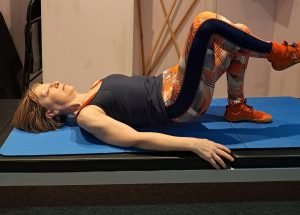
I’ve lifted up my right leg here and instead of the pelvis remaining level, it has dropped along with the leg
The point of the exercise isn’t to wave the leg about. No waving needed here, you aren’t King Charles. Unless you are. Golly. If you are King Charles, can this blog post be by Royal Appointment?
The point it to use your buttocks/glutes. The intention is to work harder in the floor leg. You have to take all your body weight through one leg and if you do that properly your pelvis remains completely level.
Solution: This exercise option takes real effort. Start with just a heel or foot lift. Feel how essential it is to stand into the floor foot to give you lift. Go really slowly.
Pelvic Thrust in the Gym
This is a hot new Bridge variation where you lean against a bench and come up with a barbell across your hips for increased load. Well, dear reader let me tell you that it is not a pretty sight. As per, people don’t understand the difference between hip extension and back extension and they are mostly thrusting their backs not using their glutes.
If a genie gave me one wish for when I’m in the gym working out (of course I will wish for world peace first), it would be for gym users to really understand this crucial difference. The difference between using the hips/glutes and overworking and arching the back. Hip flexion vs spine extension. They would lift more efficiently, be far less at risk of injury either now or in the future, and I would be less stressed out.
Suppose you can’t do Glute Bridge at all?
I have worked with loads of people who are in this situation. Generally it is due to extremely tight hips or sheer weakness in the hamstrings.
Solution: Lie on the floor and pretend to drag your heels to your bottom but without actually moving them. This is a gentle hamstring workout.
Sit to stand to sit from a chair. This is the same knee and hip opening that you get from Bridge (and you don’t have to lie down).
Side lying buttock exercises where the leg only has to lift its own body weight. In Glute Bridge the legs have to lift the whole body off the ground.
Osteoporosis and Glute Bridge
I have come across websites, watched webinars and done training programmes that teach exercises and entire programmes that are billed as spine safe or safe for people with Osteoporosis. Frequently they advise against Glute Bridge or advise that you must pivot the spine in the air and not outwardly curve it.
The reason for this is because Glute Bridge involves outwards curve, or flexion, of the spine. It is correct that spine flexion is more risky if you have Osteoporosis. It is not correct to assume that the very gentle flexion in Glute Bridge is unsafe. I defy anyone to produce evidence for that. The forces going through the spine during Glute Bridge are relatively minor. You start lying down so already there is less effort and strain in the spine. Even though the spine is outwardly curving, the lift of the body uses muscles the legs and bottom.
Pink Dumbbells instead?
Not only do I consider this to be incorrect advice regarding Glute Bridge, but in addition it is sending out the wrong message. It is labelling people with Osteoporosis as excessively fragile and incapable, who can’t possibly worry their pretty little heads and delicate spines with such a risky, dangerous and demanding exercise. What do they think we should do instead? Go for a walk and then lift some nice pink dumbbells? You know the ones: they weight half a kilo, next up from picking up a biro and the probably less than a handbag.
There is nothing wrong with 0.5 kg dumbbells. They are sometimes useful and I use them with people. There is something wrong with kettling people living with Osteoporosis into a group and keeping them “safe” with gentle exercise.
The risk with flexion does exist and I have written about it in other blog posts. If you wish you can read them here and here. The risk is not with Glute Bridge.
Conclusion
If you have got this far, now you know why there can be a whole blog post on one exercise!
If you have always disliked them, perhaps now you know why and can remedy the exercise situation.
I am big fan of Glute Bridge and can honestly say that barely a day of my life goes by when I don’t teach one. I took me a while to suss out their immense value. Once I did that, I could work out how I could teach them more effectively and know when not to use them.
Everything u say Allison is good and u explain it well very helpful x
thank you Gulshan. More Bridges next week eh!!!
Love this blog on my favourite Pilates exercise! 😊
I can’t believe it is your favourite exercise Bernadette. Because I disliked it for so long I have a heard time thinking that you might have the opposite feeling! Luckily I’m closer to you these days. Thank you for your reply. I’m glad you liked the blog.
Thanks for the tips Alison. I hope I will start doing them more competently from this point on!
I’m glad this was helpful Anne. other email on its way now too!
What a wonderful, educational post! I’m sorry I’m too far away to take your classes–I live in southern California (and per an earlier blog of yours, I, too, would love to be a mycologist, but I’d have to live somewhere that there’s rain). I’m a yoga teacher of 20+ years but always learning, and came across a Substack article describing “gluteal amnesia,” to which I responded (in my mind) “I beg your pardon”–the author recommended glute bridges so of course I wanted to see how they differed from yoga bridges, and bam! There was your article, as thorough and as fun to read as I could have wished. SO helpful! And so cheeky, if you’ll forgive the pun! My favorite approach to fitness of any type.
Thank you for making the different approaches so clear. I’ll be interspersing glute bridges with setu bandha at our next class, and we’ll all be better for it. I hope you’ll keep writing! If you ever write a book, I’ll be first in the US line for it!
Kathy thank you so much for your lovely blog reply. I am so happy that people manage to find the blogs , somehow, and they are getting read. I am sorry it has taken me so long to reply. I went on holiday on the 3rd and was just too busy to reply the day before. I am back now (from my first ever trip to Spain!!). If you go back through my blogs, there is another glute one. I don’t know about my next subject though…I have to reply on something occurring to me!