Why are so many people scared of Pilates when it can be really beneficial?
There are a few really good reasons why you might be scared of starting Pilates in a studio or a class. I’d like to use this blog post to allay those fears.
Here goes.
I’m nervous because I’m writing as an insider. I haven’t felt the fear. Well, I have actually and more on that story later. However I am definitely not a rookie and have the benefit of knowledge, strength and a lack of injuries.
On the other hand, I really know what the benefits are. If I didn’t, no blog, no business. (In case you are wondering, my fantasy alternative career is being a Mycologist).
Reason One that you are scared of Pilates: It looks intimidating.
If you check out Pilates on socials or via a normal search it looks, frankly terrifying.
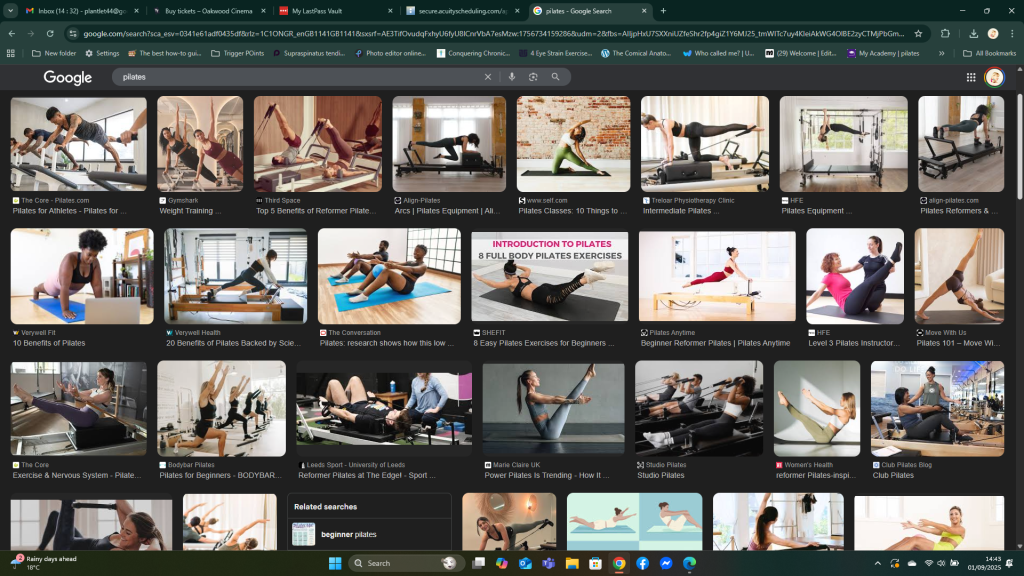
Type Pilates into a search engine and this is what you get.
The intimidation is two fold: What the people are doing? (“I mean to say, is that even humanly possible?“)
Who is doing it? (“Why is everyone be so young and thin? I never looked like that when I was 23…“)
Endless images of impossible perfection are boring, predictable and unfair. Oh, and yes, also intimidating.
Pilates is like anything else on social media or served up by a marketing guru: not entirely real.
You need to look elsewhere to find your tribe. The tribe of real people doing real Pilates with clothes that might not match and a water bottle that didn’t cost £30.
Type “Pilates class near me” and scroll past the sponsored ads and maybe even past page one of the listings. Check each website and eventually you’ll find “your” class with your people in it.
ParkRun have gone the extra mile (if you will permit me that pun) to make it more accessible. You are welcomed if you are walking, using a wheelchair or pushing a pram. Pilates has become far more accessible too, but instructors and studios offering beginners classes and easier sessions are not always the first ones you see.
Scary Reformer
Reformer Pilates is the hot fitness trend of 2025 and that combines the scary Reformer with the scary shapes those bodies are making. If you are scared of Pilates, this looks like your worst nightmare.
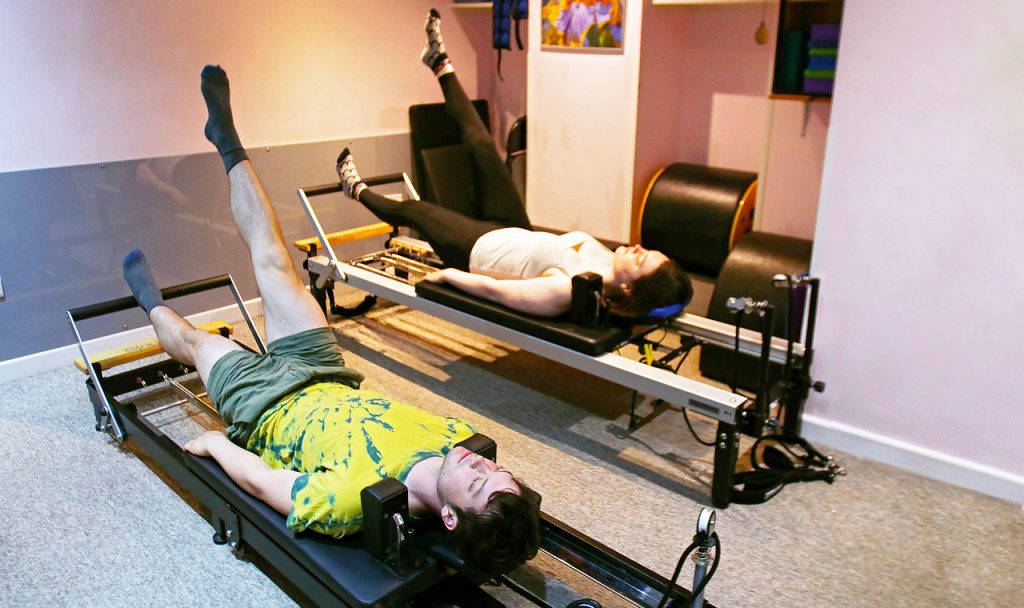
This is typical for my studio, an example from the group of exercises known as Footwork.
Ironically Reformer Pilates is even better for rehab and gentleness than matwork Pilates because you can lie down and be supported by the Reformer carriage. With the body offloaded you can more easily do strength training, mobility drills and core work.
I was supposed to go to one of the many new Reformer Studios in Leeds a while back. For once I wanted to be taught! Anyway, I didn’t go. I felt as though I would not fit in because I’m not glamourous enough. One glance at the website made me feel drab and old. I felt as if people might snigger if I turned up. The tutors are probably all lovely but the image of perfection on the website scared me off. So yeah, it affects me too.
Pilates Body
This is a real idea. A horrible, unfair, unreasonable thing. The worst that the Pilates industry can serve up. I am not prepared to bother with a description.
Are you supposed to get a Pilates body?
Or have a Pilates body to do Pilates?
There is a side hustle of this awfulness too. Instructors consumed by toxic diet culture and low self esteem because they think they should have a Pilates body and don’t.
Let’s not waste any more time dwelling upon that. I wanted to call it out as a reason why people are scared of Pilates. Shall we move on?
Talking of words though…….
Fancy language
There can be a lot of that about in Pilates classes. Anatomy, exercise names, phrases like “neutral spine”. This can become another barrier and another way that Pilates seems scary. We tutors should not use jargon. I’ve known this since I was a nurse, because it applies there too. I try not to use “industry jargon” but sometimes the odd word slips out.
Some Pilates tutors are trained to teach using metaphor. This can be a great way of encouraging movement. Even here teachers need to watch their language even. A useful metaphor for one person will be baffling to another.
There will be new vocab. I hope that isn’t too scary, but it might not help at the beginning.
Being Judged
This is related to being intimidated isn’t it. A real fear for people. Maybe for you.
I can only really speak for myself here, but I’m observing you, for sure, but not judging. I don’t have time to judge you. Don’t flatter yourself!
This is the truth. I’m 58 and I’m kind of over judging people. It is a gift of ageing. Either that or I am a slow learner.
Here is another truth.
If people struggle in class, if they struggle in my class then I take the view that it is partly down to me. Almost always, I need to adjust what I teach and how I teach it. Not ditch everything and start again, but think, plan, adjust and keep watching.
In other words, don’t be too quick to blame yourself for your “failings” in a class. People always do. Or most people do. Perhaps it’s the teacher who needs to make a change, not you.
Reason Two you are scared of Pilates: fear of not being strong enough.
Or not fit enough, not flexible enough. To be honest, it is all a variation of not good enough.
You are good enough if you are in a welcoming environment that has your back.
You could look the part but feel like you are not strong enough. Equally, you could be strong but feel that you don’t look the part. They are 2 sides of the same scared of Pilates coin.
An evolving industry
The fitness industry is very young indeed. So is the Pilates industry. And yes, there definitely is an industry, although only just, after the Pilates near death experience when Joseph Pilates died in 1967.
Both industries are evolving slowly away from their roots: being about fit people getting fitter. Or young people getting fitter, and in the case of gyms, men getting stronger.
This is all changing but the images don’t portray this.
Historically Pilates was awesomely, ridiculously hard. I’ve talked about my difficult relationship with classical Pilates in another post . This was because traditional Pilates to not accessible to my body, normal bodies and most injured ones.
There is another way to do Pilates now, where you can master the basics, get confident and get better. It is in the nature of all movement and exercise that you benefit immediately, even with the gentle stuff.
It is out there, but you’ll need to search.
Back to Basics
Some of you will be old enough to remember Delia Smith’s 1990s book “How to Cook” . If you weren’t around or at the time you were more interested in Thomas the Tank Engine, then you won’t know about the furore over Delia tackling the absolute basics.
First published in 1998, Delia’s TV programme and book were very popular and did not shy away from starting with the basics and working up

For example, she taught us all how to boil an egg and make good toast. The waspish sarcasm came and then the backlash to that: people expressed their gratitude that Delia had taken the time to write seriously about the true basics.
I like to think of myself as the Delia of Pilates. (I’m not a Norwich fan though).
However, I do feel under pressure to justify making things simple when it could be trendy and hard – A song and dance of pain, gain, either or both. That would also make it pointless and make many people scared of Pilates. I want you to feel included and feel the benefits.
I teach people how to optimise their breathing. Surely the learning to make toast of Pilates, but honestly, it is massively beneficial.
And who doesn’t enjoy good toast? (Incidentally, I’m pretty iffy at making toast. I multi task and burn it. Nobody’s perfect are they?)
Reason Three: fear of injury
This is a more niche reason to be scared of Pilates.
You might fear Pilates because you fear movement in general, because you are recovering from a fall.
It might be a recent diagnosis. I encounter this in particular with clients and class participants with Osteoporosis.
Another fear I encounter a lot is with people with a history, long or short, of back pain.
Perhaps you’ve done Pilates before and been injured.
I have had a few clients who were scared because their kids said they’d never manage.
The setting matters here
It is comparatively easy to allay your fear of injury when the Pilates in a 1:1 session. In my studio I can take things as gently as you need and then observe very carefully. I can then point out improvements and change along the way.
In truth, this is harder to do in a group setting. No matter how carefully I observe, I can’t see anything. No tutor can.
If you can afford it, book a 1:1 session. Perhaps you can’t, or, ironically, you find the idea of 1:1 rather scary. Yes that is very common indeed! If that is you, you’re not alone there either.
If 1:1 is not an option, then try to chose the right class at the right pace. Of course the ball is back in the tutor’s court then because we need to accurately describe the classes.
Talk to us!
Perhaps the simplest solution here is to phone up the teacher and say how you feel. The tutor can talk about class options and maybe visiting the teaching space. When a good, sensitive tutor knows how you feel then they are best able to help you.
Trust your Pilates Instructor.
That is a big ask but else can I do?
A good instructor will listen and alter a 1:1 session to reflect your feelings. The entire premise of my back care Pilates courses has this baked in.
It is harder in a group class though.
In a class, tell the instructor and don’t be afraid to take things at your own pace. With Pilates that is what being at the back of class is for. The back isn’t for the rebels, it is for the taking things gentler brigade. And it is a brigade. You are not alone.
I can still see you though!
And if an instructor doesn’t acknowledge your fears, find another one.
Reason 4: could it be me?
It is quite hard to write this.
Here goes again.
Am I too gobby, too young, or too old? My muscle definition is pretty reasonable. That might be intimidating. I appear to be able to do everything with relative ease.
At least that last one can be debunked. I am excellent at performing one repetition of almost everything. If I can’t do an exercise, I rarely teach it because it impacts my ability to teach it properly.
Another pitfall. Coming across as a “know it all”.
Recently I had a helpful conversation with someone who pointed out that I had communicated very badly with her, coming across as a “know it all” in a very unhelpful way. It was extremely valuable feedback and rare.
Most people who are pissed off with me or unimpressed vote with their feet, not with their feedback. Working alone in my business means there is no team to observe and comment on my work or share ideas with. In addition, I have to know what I am talking about in order to do my job, but that can cross a line into being arrogant. I am genuinely scared of that and yes, it happens.
So yes it could be me. Or another teacher
I have met a huge number in my fitness career. They have been fellow trainees, colleagues and my teachers. Virtually every single one was a nice person who wanted to do their best at their job. In fact I can’t really think of one that wasn’t and I reckon I would remember.
However, sometimes we cock up. Most of us are garrulous, we talk for a living and say the wrong thing sometimes. Teaching in public means our cock ups can potentially be, not only hurtful and embarrassing, but heard by others.
As per, I can only speak for myself here but I’ve said some stupid things over the years. It makes me cringe but I can’t turn back the clock. Only hope to steadily improve.
To conclude
I think it is entirely valid for you to be scared of Pilates. I’ve given a few reasons and that doesn’t even include the notion of it being new. Starting Pilates shares that with other things.
I do hope, however, that you can find a class somewhere, or a studio, (or my studio) to dip your toe in the Pilates waters. I do hope that you won’t regret it.