Forward bending with Osteoporosis? Surely not!
I have Osteoporosis in my spine and I do spine curls. I forward bend too, shock horror! There is quite a lot of confusion about whether spine curls and forward bending with Osteoporosis is safe. That makes it really hard to decide what to do in your own life, so I thought I’d write about what I do and why.
Why is forward bending with Osteoporosis considered to be risky?
Forward bending of the spine compresses the spine. It kind of has to, in order for you to do the bending. The forward bend compresses the front of the spine bones (vertebrae) and relatively speaking, opens them up at the back. It is the compression that makes the bones more prone to fracture.
There are additional factors that make the make the front portion of these bones vulnerable. The jelly like disc in between the spine bones has to move backwards to allow for the forward bending. The disc therefore gives the bone at the front less protection. The front portion of the bone is inherently less dense and more prone to fracture. (By front I mean the bit of the spine that faces into the body.)
Why is forward bending with Osteoporosis unsafe but backward bending is Ok?
No one ever mentions this does they? In a back bend you compress the spine in the opposite direction. How come that is safe?
There are extra joints at the back of the vertebrae called facet joints. The facets share the compressive load of the back bend with the main body of the vertebrae. There are big, strong ligaments running top to bottom along the spine at the back. They also absorb some of the compressive load of back bending.
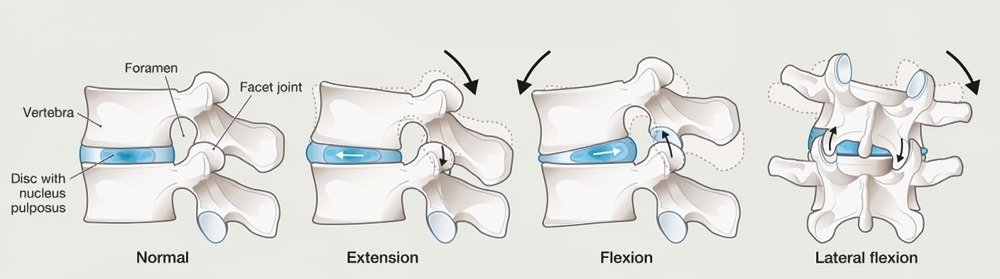
Picture one. Vertebrae at rest with the bones neatly stacked and the facet joints at the back of the spine pointing backwards. Picture two with the spine in extension (back bending). The bones get closer at the back, open at the front and the disc protrudes at the front. Picture Three, with the spine in flexion (forward bending). Here the bones are compressed at the front and the disc protrudes to the back. Picture Four shows lateral flexion (side bending) there there is compression, but to one side only.
Are there any rules to follow if you are forward bending with Osteoporosis?
Not as such. Everyone says something different. The Royal Osteoporosis Society do not suggest that every one should avoid forward bending. Their approach is quite nuanced and it is summarised here.
On the other hand, I took a specialist course from a highly reputable training provider, all about teaching exercise for Osteoporosis. With their entry level qualification, all spine forward bending, side bending and even rotation is completely contra indicated for all class participants.
The problem is that there are so many variables.
Variable One: Osteoporosis can vary considerably in its severity.
Variable Two: Other factors that play into whether your spine might withstand forward bending, or not.
Variable Three: spine curling covers a vast array of different types of moves.
In short, not all Osteoporosis is the same, not all bodies are the same and not even all forward bending movements are the same. It is no surprise that it is hard to decide what to do!
Not all Osteoporosis is the same.
Osteoporosis is diagnosed via a DEXA scan. You bone density is measured via a number called a T score and there is good explanation of what your T Score means here.
The lower the T score, the more severe your Osteoporosis. There is also the issue of whether your T score changes over time. Is it getting worse, staying the same or even improving? Very clearly, the greater the severity of the disease, the greater the risk of fracture. With a greater the risk of fracture comes a greater need to avoid spine forward bending.
Beyond a diagnosis of Osteoporosis, there are other ways to look at the resilience of the bones.
We tend to focus on the density of bones. It is the main metric used when considering if bones are healthy, because it is measurable and can be tracked over time. It is especially useful if you are on medication and you want to know if the meds are working.
However there is more to bones health than merely density. Really we need to ask: are the bones robust and strong? You can’t really measure it, but robust bones are ones that are subjected to push and pull forces on a regular basis. Those forces need to act in multiple directions. Basically I am describing a spine that undergoes complex, strong movements constantly. In our modern lives those complex strong movements are most likely to come from exercise in the form of strength training. However some can come from activities of daily living done with great alignment or things like dancing, skipping, stair climbing, regularly getting down on the floor and getting up again.
This sense of robust, strong bones is a crucial aspect of bone health that is not highlighted enough. Bones need to be robust and fit for purpose. The more robust they are the better able they are to cope with forward bending. However, we cannot measure robustness.
What might be a proxy for the robustness of bones?
Well some of them are the same as for loss of density: loss of height, increased curvature of the upper back. However, so is fractures in the absence of a diagnosis of Osteoporosis.
General weakness is an indicator of a lack of robustness because muscle weakness and bone weakness are linked. They have to be. Muscles are the thing that move bones. Moving muscles is the way you “reach” bones. You cannot make a bone move without moving a muscle, or the fascia.
What is forward bending?
It is an awful lot of things!
In life.
We can forward bend the spine a lot or a bit, to pick something up from the floor, tie our shoes or pick up a stray weed from the garden. Most people, most of the time, use spine bending to accomplish these movements. However it is possible and advisable to move from the hips. This is known as a hip hinge. I have talked about this in another blog so I am not going to address here the pros and cons of spine vs hip flexion but you can read that blog here.
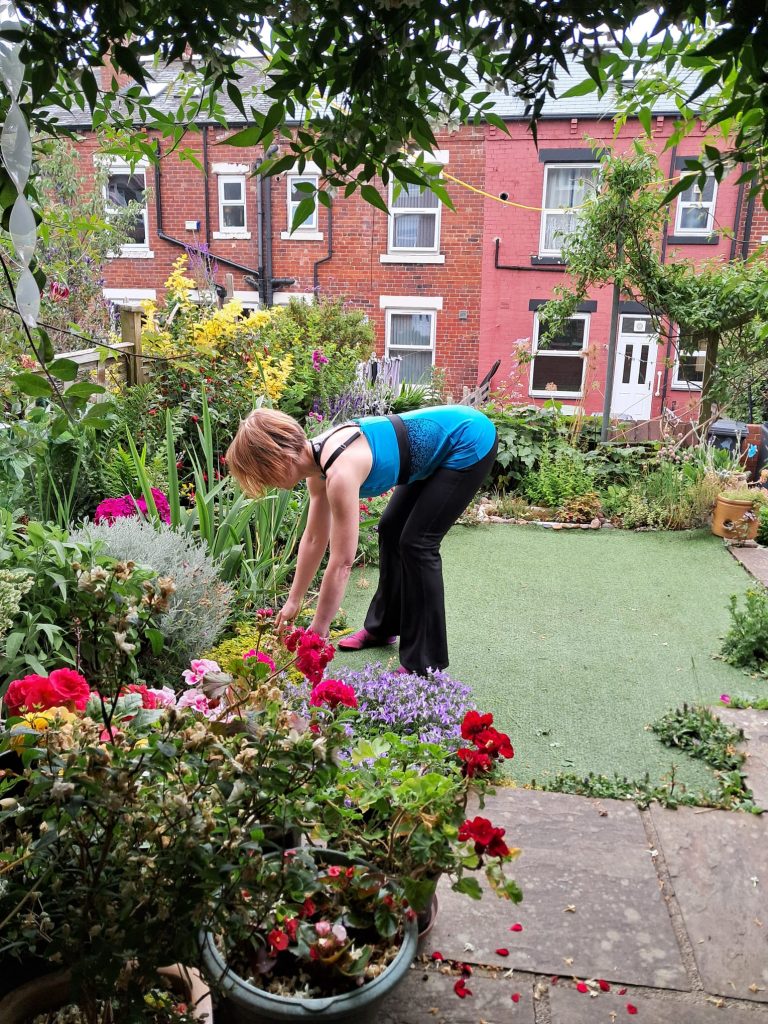
Bending forwards to garden using a hip hinge

Bending forwards to garden, bending from the spine.
Sitting in a rather slumped position requires the spine to be over rounded. We tend to sleep in a bent forward position.
Seeing as we do this all the time, does it imply that forward bending is ok because we have “got away with it”? Alternatively, should we avoid adding more into our daily lives?
I take the view that if at all possible, I’ll sit tall and stand tall as standard, with my spine in an ideal alignment. I don’t just allow it to round because it’s easier or habitual. Absolutely, I might forget and end up in that position, hence trying to do the right thing when I am aware of what I’m doing.
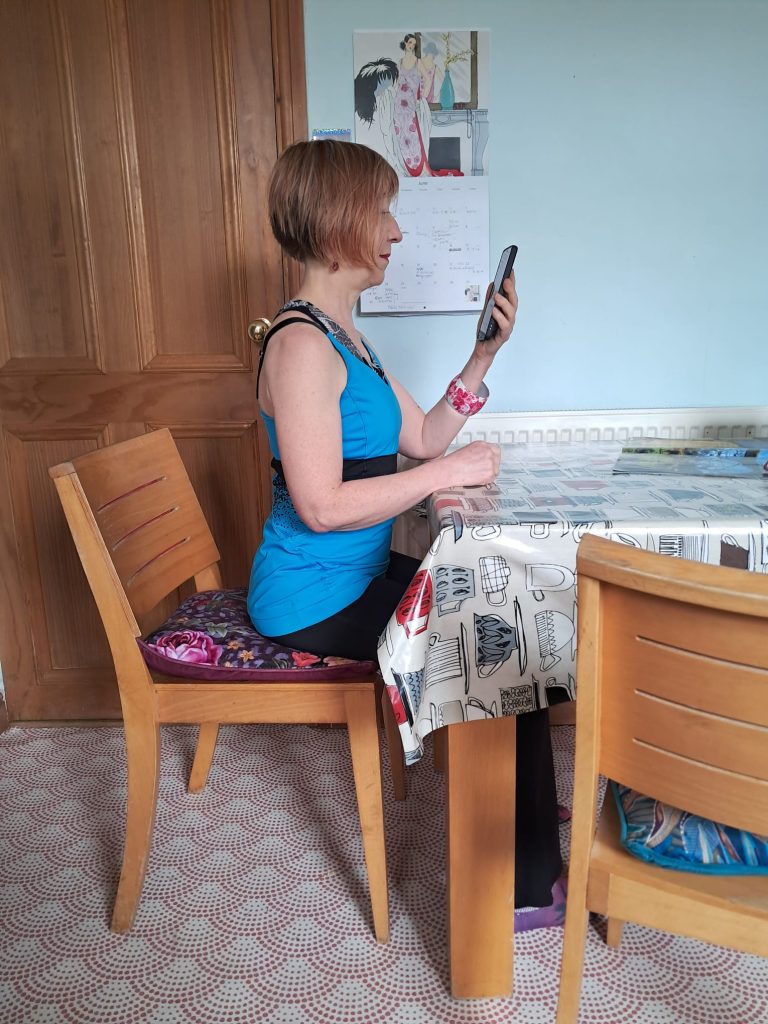
Sitting with an ideal and idealised straight spine, sitting tall!
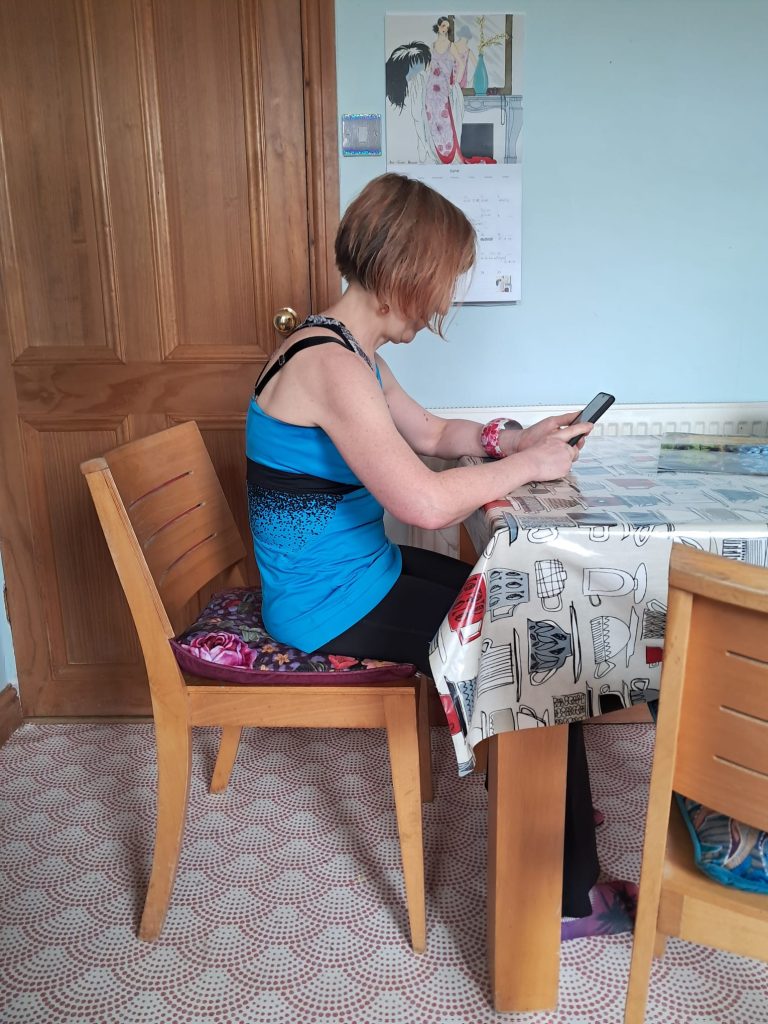
If you are avoiding forward bending with Osteoporosis, this kind of sitting posture should be avoided.
Your classic forward bend is the Ab curl and the Oblique Ab curl.
During Exercise.

Oblique spine curl. There is 2 kinds of spine movement here: forward bending with rotation.

This is normal, standard issue, spine curl, or Ab curl.
Even harder: done with the legs lifted (more flexion and more load) as in the picture below.

Much safer is bending the spine from an All Four position: that is your classic Cat/Cow, pictured below. It is safer because the weight of the legs and the upper body is not hanging off the bent spine. The load is instead shared with the legs and arms.
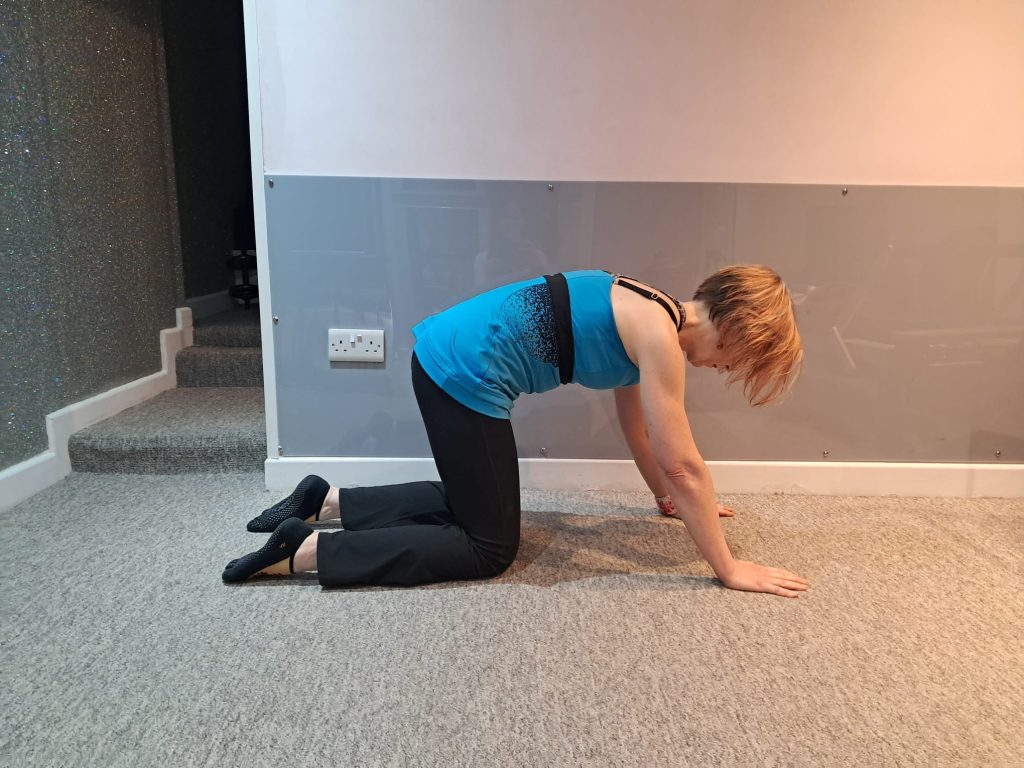
You can forward bend and side bend from standing too.

Unofficially, a huge amount of spine bending takes place by accident because people have poor alignment and technique during the exercises. This really does needs to be eliminated. Whatever you are doing in an exercise setting needs to be with great form and the best alignment you can manage.
Spine bending in an exercise setting is safer if done slowly and carefully.
All forward bending is safer if you perform it in one plane of movement. In the Oblique curl you are adding rotation and to the compressive forces are acting over 2 directions and so it is more risky.
What do I do?
Forward bending with Osteoporosis with my daily activities.
I am fortunate to understand how best to move safely and how best to maintain good alignment. I teach this to people all the time so, yes you can learn too. It is not complicated, just hard to implement all the time.
I really do consider my alignment and the quality of my movement as much as I possibly can. In other words, I put my knowledge into practice!
As I type this I’m doing my best to sit tall. Since I got a new laptop I cannot see the screen properly and it is making me crane my head and neck forwards which is terrible alignment. I know I am being naughty and the solution is to buy a screen. It is costly at around at least £65 but I will just have to do it.
Forward bending with Osteoporosis with during my exercise regime.
With my exercise regime I am doing my best to beef up the entire system to develop healthy ligaments, tendons, muscles, fascia and bone as well. Over time this will contribute to my bones being more robust. and better protected.
I would say that I don’t do enough, and manage about as much as I can cope with at the present time. Time constraints thwart me (and sometimes laziness!)
I do not do spine curls (from lying on my back) as part of my regular exercise regime. However, I do teach them, and thus do them quite regularly. When that happens I apply the following rules. Go slowly, carefully and take care to distribute the forward bending through the entire spine rather than to curl badly and over curl in some places and not other. This is an incredibly important point and is often missed. You want small, roughly equal amount between each pair of bones.
I regularly do side bends (very carefully), rotation, and back bending, This is to keep my spine mobile.
I do weight training. This involves positions where the spine is ideally aligned (neutral), then I add resistance via dumbbells or exercise bands. In the gym I work with bigger loads using barbells or machines. This is all to make my bones and my system more robust. Making my bones stronger is the indirect effect of going after muscular strength even though my goal is improvements in the bone. Examples of what I do are Press Ups, Deadlifts, Bench Press, Pull Ups and handing from an overhead bar
What I avoid.
Extreme Ab work of the kind that is very fashionable and this includes some classic Pilates exercises like the Hundred.
Head stands. I am weirdly scared of these in Yoga. I don’t even know if they are risky but I don’t do them. Even though I am supposed to be knowledgeable and rational, when it comes to fear of injury to the bones, I am not immune to my emotions affecting my behaviour.
Any spine curling really fast. Not even back bends. Compressing the spine at speed is risky.
Forward Bending with Osteoporosis isn’t the biggest risk I face
That would be getting on my bicycle. It isn’t the cycling, it is the risk of being knocked off that is dangerous for me and my spine. Yet again, my emotions are dictating what I do. I am ignoring the risk in this case.
I try not to think about the risk of cycling. Every so often, after I’ve had a near miss, I do think about it. Very occasionally I stand at the top the stairs in my house and have a little moment of existential dread about the idea of falling. I try to park that and then tell myself that if I make my bones as robust as possible, they will be ok. Fortunately, I have never had a spinal fracture. That makes it easier to downgrade the risk or manage my concerns.
I try not to be blasé about forward bending though. The aim is always to be as sensible and safe as I can and control what I can.
Conclusion
It is so hard to know where to turn for advice. Beyond that it is hard for people to give advice because everyone has a different risk profile. I don’t think it is especially useful to say “don’t forward bend” either. It is far more beneficial to say to yourself:
“I will stand tall, sit tall and move about in life with the best alignment that I can possibly manage”.
In other words, focus on what you do as much as what you are trying to avoid. If you have previous fractures or increased curvature of your mid/upper back you do need to be very careful but on the other hand we all need to live our lives. Fear of movement is unhelpful too.
I take the view that exercise and strength training is hugely beneficial if done safely and sensibly. The risks with spines is more likely to come from chronically poor alignment in daily life. The benefits of strength training go beyond improvements in the bone. It improves balance, helps the heart and circulation, and strengthens that other element that we need: confidence.
This is the best explanation I’ve heard. I like that you included pictures of the spine in different postures, very helpful to have the visual. I also like the way you have explained daily life activities and how we move in these specific ways on a daily basis. We move in these ways all the time so it’s not one size fits all! Moving mindfully and being aware of our posture is key. Thank you, Michelle
thank you Michelle. I am so glad you found the blog helpful. You are right about being aware of how me move: it is so important. That and strength.
V. helpful – my GP is in a flap over my recent DEXA scan (I am not) & your explanations with graphics is super-useful so I know how to continue my exercising.
Wish I lived in Leeds!
Thanks x
thank you for your reply Jane! I suppose it is nice that your GP is involved and cares about you.
I do have some resources on my YouTube channel The link is here but you will have to copy and paste it into your browser.
https://www.youtube.com/@PilatesLeeds
I am planning to extend those clips. there is an Osteoporosis playlist too. . To be honest you can request something! I struggle for content ideas sometimes.