Going back to my roots with the legacy of Joseph Pilates
I owe Joseph Pilates a lot. My very existence is bound up with being a Pilates Instructor. It is my livelihood, my occupation, my enduring and enjoyable preoccupation. The legacy of Joseph Pilates provides for my daily existence and yet I have been guilty of side-lining the man and his invention.
My Pilates based New Year resolution is to bring Joseph back into the Pilates. Honouring his original work in my classes and in my studio.
Where it all began for me
When I started training in 2004, the introductory matwork course included a section about the history of Pilates and Joseph Pilates.
I subsequently did two further big matwork training courses, starting in 2006. Frustratingly I did not complete the first, hence the second one. Both were Classical Pilates and steeped in the legacy of Joseph Pilates.
What is Classical Pilates?
Classical Pilates is a form of Pilates that adheres very closely to the work of Joseph Pilates. It uses his published work, the knowledge that he imparted to the people closest to him up to his death in 1967, and archival images and footage as a basis of the method. Classical matwork is based entirely around the original 34 matwork exercises.
When I first trained I didn’t particularly question this, I thought that was Pilates. However, I struggled a lot with the exercises. They are incredibly advanced and I only half understood them and crucially didn’t grasp, why those exercises?
Looking back I felt that both trainings placed too much emphasis upon making the necessary classical shapes at the expense of true understanding of why we were doing them.
What is Contemporary Pilates?
This is a rather scholarly article but it a succinct comparison of classical, contemporary and clinical Pilates. Yes, clinical Pilates is another iteration of the method.
Contemporary Pilates was borne out of the need that some teachers identified, to modify the method to make it easier. Joseph Pilates originally developed his method on dancers and in a time when people in general were less sedentary and smaller. He was crystal clear on the need to practice constantly and thoroughly, perfecting one exercise before learning the next. Our bodies, our sedentary lifestyles and our busy or over busy lives with far more temptations and demands upon our free time are not congruent with perfecting his method.
Before I knew about the classical vs contemporary debate, I began to realise that simpler exercises worked better in classes. Bit by bit I acquired a library of modified or even totally new exercises and mainly I taught them.
Ignoring the legacy of Joseph Pilates – my anti classical phase
It was borne out of 2 things in particular. Firstly I really struggled with the classical exercises. When it comes to Matwork, there are only 34 of them. If you cannot do those, then there are no alternatives.
I have various things going on in my body which made the exercises either tricky or downright unsuitable. For example, after my 2nd pregnancy and childbirth, I had an unhealed diastasis recti and the emphasis on strong spine curling exercises was far too extreme for my body then, and now. I knew how I felt struggling and failing with classical Pilates and didn’t want to impose that in my classes.
At the same time I learnt more about foot health, about breathing, shoulders function and anatomy. You name it really. As a result, increasingly, I began teaching more niched down exercises and still will do, forever probably! It is extremely valuable to focus on parts of the body in isolation. But that does come at the expense of full body exercises like those of the classical repertoire.
Failing miserably in classical Pilates classes
This was a feature of my Pilates training courses in the early days. Then, during the pandemic when I did online Pilates, in the end I had to lapse two memberships because I was getting so upset at my inability to do the exercises. I felt like a bit of a failure because I couldn’t do all the exercises with apparent ease. I because even more anti classical.
The whole thing ended up having a major effect upon me. It made me want to make my classes as inclusive as possible. Starting gentle and easy and building up.
Pilates for everybody and anybody.
This can’t entirely work of course, but it is an element of my approach and philosophy.
Client Centred Pilates
The second issue that sent me away from classical Pilates, is that my approach is client centred and not exercise centred. There are many ways that the classical approach plays out when taught by different people, but essentially the method is taught with the same exercises in the same order. The approach is method related. Apply the method and the body adapts.
In a client centred approach you start with the body and chose the exercises that suit the body. The body then adapts. I am client centred in my approach.
I do want to say here, that every teacher basically client centred, and the differences are a matter of emphasis and philosophy not because any teacher cares more or less about their clients.
My relationship with the Hundred Exercise illustrates my anti classical stance
If ever there was an exercise that led me away from Classical Pilates and Joseph Pilates’ original work, it is the Hundred.
In classical matwork Pilates, participants begin each session with an exercise called the Hundred. There is a good description and pictures here.
The shape required is extreme, the length of time required to hold the shape is similarly extreme. The vast majority of people I have taught are not really able to easily start an exercise session with the Hundred. To be honest most people can’t do it ever, and a lot of people who think they can do the Hundred are mistaken.
If you scan the internet for talk of classical Pilates or the Pilates Hundred in general you will get back a lot of people extoling the virtues of the exercise. This sounds rather mean spirited but beware of this talk, of the marvel of the Hundred. I’ve spent years teaching exercise and Pilates and the Hundred is very tough and frankly, best avoided or treated with caution. I would have anxieties about most people attempting it in all it’s extreme glory because getting it wrong will strain the back, the abdominals and cause excess pressure in the trunk which could exacerbate pelvic organ prolapse and pelvic floor dysfunction.
There are many useful elements in this exercise. However, I simply do not agree that you can learn them by doing the exercise itself. It is an exercise of breathing and we kid ourselves if we think our breathing patterns would even pass muster for this exercise. Optimal breathing can be taught and trained, but separately, not during the Hundred. My difficulties with the Hundred have preoccupied me for ages and I have written about that in a previous blog post.
Watching Pilates evolve
As I have been ploughing my contemporary Pilates furrow over the years I have seen Pilates go global, go mainstream and go off in new directions.
I have also seen the nature of Pilates training change substantially. You can call yourself a Pilates instructor after a weekend of training and that isn’t going to give you time for considering the legacy of Joseph Pilates is it?
We have Hot Pilates, Yogalates, HIIT Pilates and even without a snappy moniker, those evergreens that attract people to Pilates: flat stomach Pilates, Pilates that doesn’t give you big muscles. Of course, Core Pilates.
In 2024, Reformer Pilates was the hot trend of the fitness world, I’ve no doubt it will remain top of the exercise pops in 2025.
The way this new trend shows up in marketing terms, reflects the industry. There is talk of wellness, of the mind body connection, and inevitably of the core. There is some substance, and a great deal of style.
You’d be forgiven for assuming that to show up to a Reformer class these days requires false lashes and a trip to Lulu Lemon. What you probably don’t need is any awareness of the history or provenance of Pilates. No legacy of Joseph Pilates. I’m sure most people don’t even know that there was an inventor called Joseph Pilates. If that is you, have a look at this, informal blog that I wrote about him.
Joseph Pilates is being lost from his own invention and I’ve been part of that.
Over the years I’ve learnt more about anatomy, about other kinds of exercises, about the human body and about how bodies move and adapt to life, to injury, to aging. This in turn has led me to a far greater understanding of the Pilates method as envisaged by Joseph Pilates.
Like a Pilates engineer, I’ve stripped down all of Joseph Pilates’ exercises and put them back together again. I have far greater insight into the value of them all, and importantly, each one as part of an overall system.
I want to teach his exercises far more than I have done in the last decade or so. Now I have the skill to go about that in a way that I can bring participants with me, not put them off. I have the knowledge to help me chose the right exercsie in the right context for the right exercise related outcome.
So what am I going to do about it and why?
The WHY is easier.
Because the method and his exercises are amazing, inventive, creative, interesting and effective. Joseph Pilates deserves more recognition and for Pilates to be more than a core workout.
HOW is much harder.
I need to find a way of enabling normal people with normal bodies to do these complex and demanding exercise.
This will sound like heresy to some, but having jettisoned the strict order of the exercises, I will not return to it. Instead I am going to make them the apex of the class rather than the whole thing with a choice of one or two that are suitable for the classes that I am teaching.
I’ve already made a start, using them more in my 1:1 work. I have been choosing exercises that have purpose within the 1;1 session and fit with the aims of the session or the goals of the client.
With the Pilates apparatus that I have: the Reformers and the Wunda Chair, I have remained closer to my classical roots and stuck more to the original repertoire from the get go.
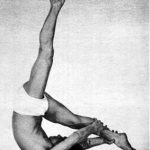
Oh, and one last thing. I will never expect anyone to show up to class in nothing but a pair of white underpants.
Hi Alison, I also had never heard of Joseph Pilates, The Email is very informative, Enjoyed reading it, Thank goodness we don’t have to turn up in white underpants lol 😀, Happy New year and looking forward to Wednesday session,Kind regards ,Jacky
It is interesting that you haven’t heard of Joseph Pilates, Jacky. I really should have told you all about him, but at least now I have! I think that when I teach his original work I need to reference him at the same time.