Spine strength seems obvious as a concept, but is it really? How on earth do you set about strengthening your spine?
Spine strength, much like the spine, is out of sight and out of mind. Spine strength might be out of mind, but luckily it is not out of reach!
I’ll try to explain but this blog is longer and more complicated than I had planned. Here goes……
What do I mean by strength?
Ideally, we are all strong enough to manage the movements we need to easily navigate our daily lives. This is functional strength. The kind that allows you to go up and down a flight of stairs, get down on the floor or lift a kettle full of water. You can subdivide that further to the kind of strength to keep going: sometimes referred to as stamina. So, being able to walk 5 km, as opposed to having the strength to get up from a very low chair.
Getting up from a low chair, or harder but related, performing a deep squat, or harder still squatting with a load, known as a deadlift (pictured below), require a more overt kind of strength.
Think of it as a kind of continuum of leg strength which delivers the ability to walk on one end, to deadlifting your own bodyweight on the other. The latter is not intended to be something you do for hours and hours.


How does that relate to the spine?
It is not quite as obvious but it is basically the same idea. Your spine supports your trunk, and head, and shoulders/arms. The legs attach into the pelvis and the base of the spine sits in-between the pelvic halves. Everything is connected. Your spine is supporting you throughout the activities that I just mentioned.
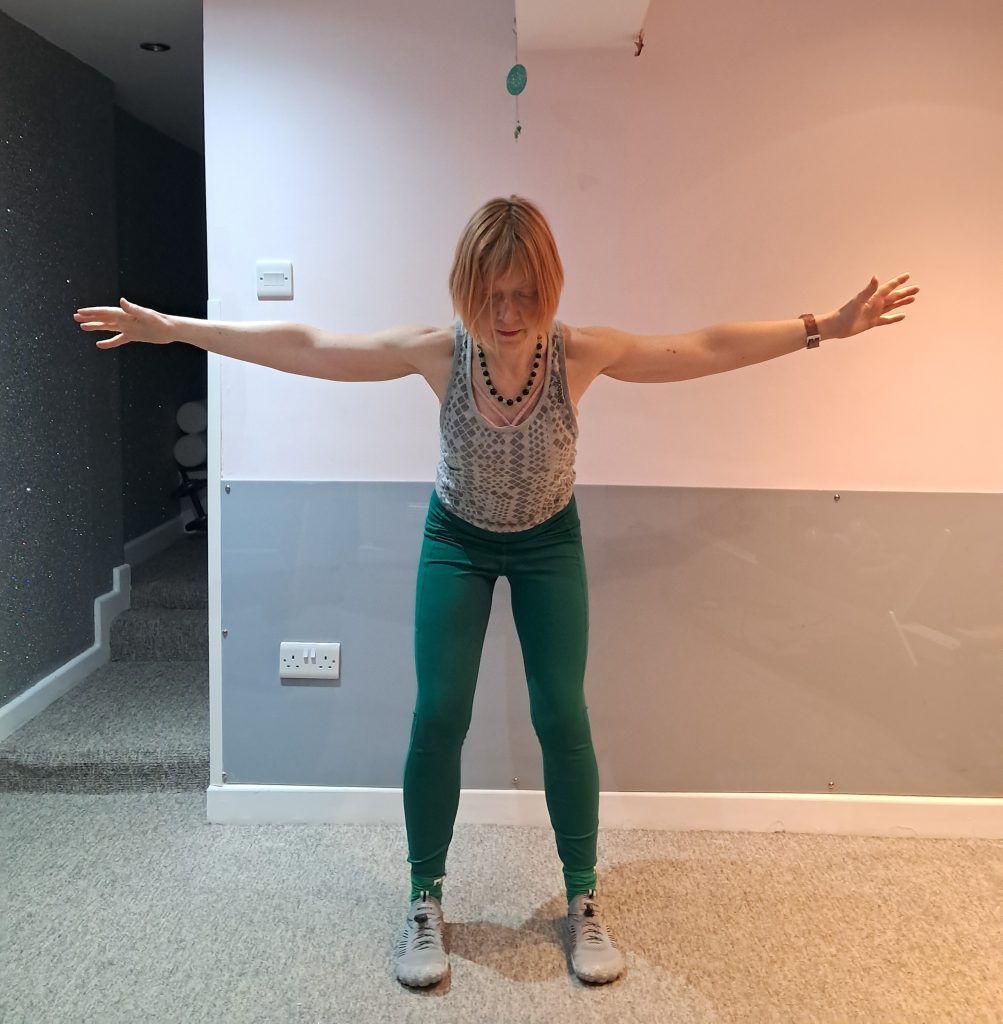
Here is a more spine orientated continuum of strength. Standing and reaching the arms overhead, as opposed to harder, reaching a weighted bar overhead. Here is another example: hip hinging your body forwards (where gravity is acting to tip you forwards but the spine and legs are keeping you in up. Harder would be a hip hinge with added arm movements, (pictured) or arm movements with hand held weights.

Most of the time we mean muscles. That is the default assumption. Strength = muscles. However it is also a property of bone and also the things that connect bones to bones and bones to muscles: ligaments and tendons.
What is it that is strong, or gets stronger?
In addition we need to include the stuff that surrounds the whole lot of bones, joints and muscles. This is fascia. Slowly but surely, if you are strength training (again, think continuum of walking through to deadlifting) the breathing, heart and circulation improve and, increase their efficiency.
Do I even mean strength?
Really, I mean adaptation. It is a better term. Everything adapts.
The notion of strength doesn’t entirely represent what different bits of the body do when they each react to exercise, strength training or alterations in our daily habits. The notion of adaptation covers all bases and allows for the reverse process. Sadly, we adapt to being sedentary or moving less due to chronic illness. The biochemistry of each cell certainly doesn’t get stronger as such, but does adapt.
Biochemistry? Where did that spring from. I was a biochemist once. It is dear to my heart!
Now, back to spine strength.
How do bones get stronger?
Bones build themselves. Put very simply, throughout our lives there is an interplay within the bones, between bone building cells, called Osteoblasts, and bone remodelling/recycling cells called Osteoclasts.
Bone also contains another cell type, Osteocytes. These sense the stresses placed on bone and can signal to the Osteoblasts and Osteoclasts to increase their activity.
I’m trying to keep things very brief here and so if you want more detail on this, put in simple terms, read this article.
Bone remodelling is under the control of many hormones. The important ones are Parathyroid Hormone, Oestrogen, Growth Hormone, Thyroid Hormone, Calcitonin and Glucocorticoids.
I’m not going to go into any detail at all here but wanted to list all the hormones simply as a reminder that it isn’t just all about Oestrogen. Due to the clear link with menopause and Osteoporosis we’d be forgiven for thinking that Oestrogen is the only hormone of importance. However, that isn’t the case. If you’d like to have a bit more detail on the other hormones, here is an article on how each hormone affects bone.
One last thing: Wolff’s Law
Wolff’s law states that bones adapt to the mechanical loads placed upon them, becoming stronger and thicker to resist increased forces. This law was developed by German surgeon Julius Wolff in the 19th century and is described nicely here.
A bit of translation: mechanical load is really just the push/pull of outside forces acting on the body. Or it is the body itself moving and resisting the pull of gravity. Lifting weights in the gym, body weight exercises, jumping, skipping, squatting, carrying shopping, climbing stairs. These are examples of mechanical load acting on the body. The more you do, the more you adapt. The reverse is also true, in yet another form of “use it or lose it”.
This is very important indeed. Bones respond to the demands placed upon them. The more you work your body, by whatever means, the greater the adaptation. Strength training leads to greater strength. An absence of strength training, functional movement, or by being too sedentary, causes the opposite to occur and the bones to lose strength and get weaker and more prone to breaking.
Implications of Wolff’s Law if you have Osteoporosis
Once the cause has been established, the main treatment for Osteoporosis from the NHS is medication. There are a range of these available depending upon the severity of the disease. Other factors at play are whether you have broken bones in the past, what medication you can tolerate, possible interactions with other medication. I am not denying the vital role of mediation and take a weekly dose of Alendronic Acid.
However, if we do not signal to the bones to get stronger by doing some kind of strength training, then according to Wolff’s Law, they won’t get stronger. The medication is trying to overcome Wolff’s Law that is, by building bone without placing extra mechanical stress (load, strength training) on the bone. This might work but shouldn’t we all, where possible, be trying to signal to our bones to get stronger by strength training?
Although I think it is valid to call out the need for extra strength training, there are multiple causes of Osteoporosis and strength training won’t solve everything either.
Which brings us, finally, to the spine strength and how you go about getting it.
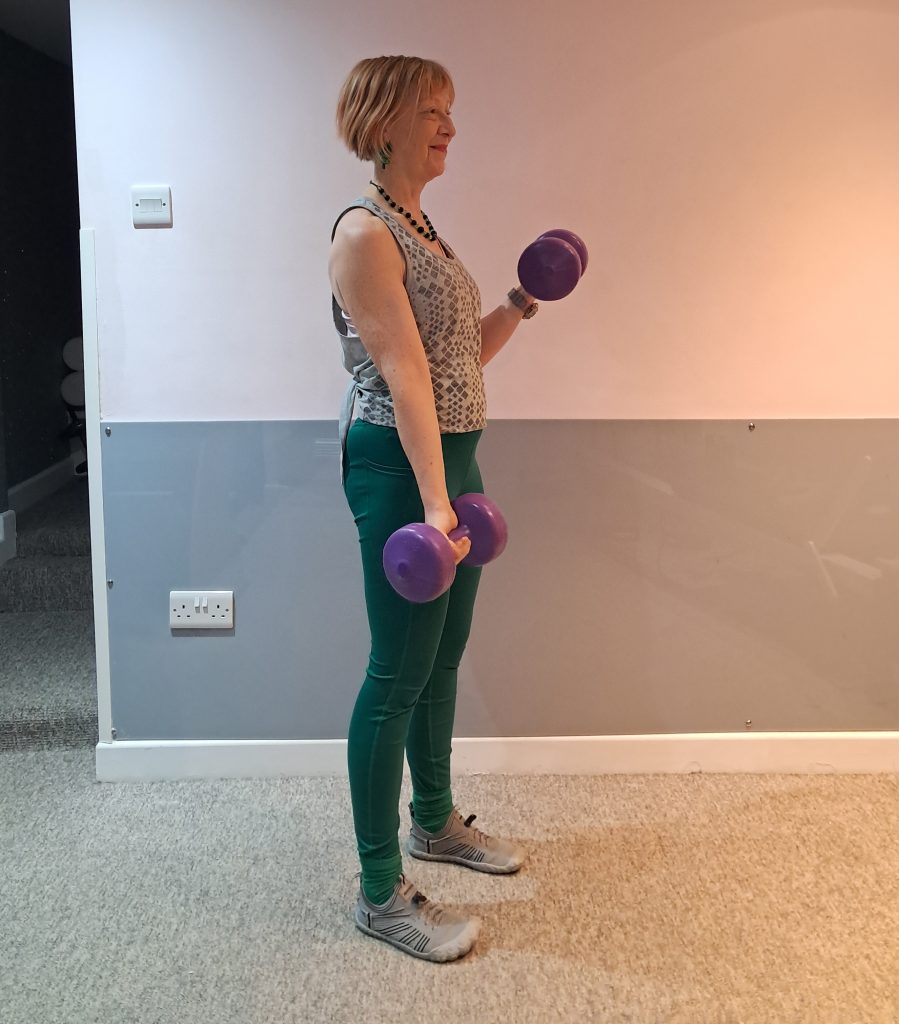
A bicep curl (pictured below) is an exercise where you bend and straighten the elbow with the arm tucked in beside your body. The main muscle is the one at the front of the upper arm, the Bicep. Doing the exercise will increase strength in the bicep muscle but also in the connective tissue that connects the muscle to the bones. If you apply Wolff’s law, as the bones are tugged, pulled and loaded, they will respond, (albeit more slowly than the muscles), adapt and get stronger.
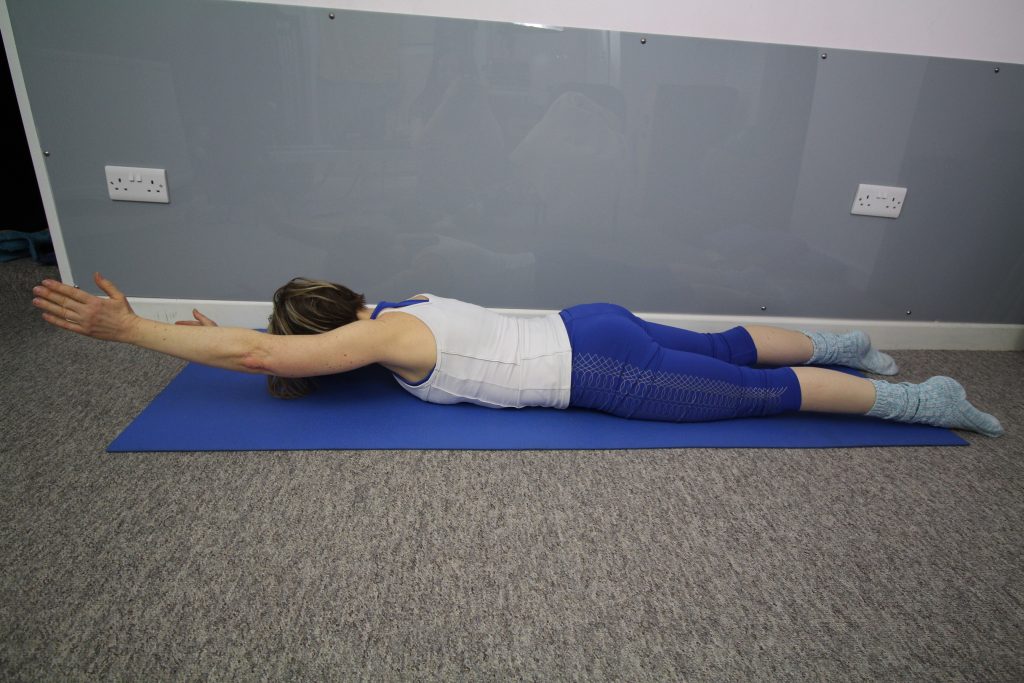
If you follow the logic of do arm exercises to strengthen the arm bones, then you’d have to do back bends to strengthen the spine. A back bend is when, for example, you lie on your front and bend the spine up, head first. In theory, if you get the exercise correct, you use the spine muscles and therefore load the spine directly, to lift the body. There is a direct relationship between the load which is body weight and the muscles (and therefore bones), doing the lifting.
The Dart exercise is an example of this (pictured below), and if we were relying on backbends for spine strength we’d be in trouble. Can you really see us doing these for 30 minutes in the gym or Pilates studio?
Luckily it’s not that simple.
You can target the spine indirectly. That is, do strength training which is spine adjacent, and still strengthen the spine.
For strength, read: adapt. Or read: the Osteocytes detect the increased pull on the bones and signal to the Osteoblasts to make the bones stronger, more resilient.
Nothing in the bone/muscle/fascia system really works in isolation. If you load your shoulders, then because they attach into your trunk, working them works the spine as well. The same applies with the legs. The thigh and buttock muscles attach into the pelvis which connects directly the spine.
Obviously the spine is at the back of the body, as are the muscles that directly surround and move the spine. The load that you are lifting, to indirectly work the spine, needs to be acting at the back of the body too. This isn’t 100% accurate but it will do as a rule of thumb. A rule of spine so to speak.
There are exercises that tug on the spine bones when the spine is changing shape, like the back bend mentioned in the earlier paragraph. There are exercises or functional movements that pull on the spine but it doesn’t change shape. Here, the challenge for the spine to remain in the same shape, is the work. A deadlift is an example of this. The spine, and surrounding muscles are resisting shape change.
Work at the back to work the back.
For example, over head press, pull ups, deadlift, back squat.
During a deadlift, you lift the barbell and the work is in the entire back of the body, resisting, for want of a better word, temptation, to let go and drop the barbell forwards.
With a Pull Up you are pulling your bodyweight upwards using back, shoulder and arm muscles and there is considerable force pulling indirectly on the spine. When performing an overhead press you straighten your arms to the ceiling whilst holding a bar or two dumbbells. It is pictured here.

If you stand on one leg, you load the spine. This is where it starts to get more vague.
Standing on one leg to achieve spine strength.
Humans are eye dominant animals that stand on two legs, for the most part, looking forwards.
We see our front bodies, We notice them. One of the USPs of the genus Homo is how we use our hands, generally, when they are right in front of us.
The notion that we are held up via contact with the floor with forces that run from the soles of the feet up the back of the body is, almost hidden, and definitely not something we reflect upon much.
If you lob into that, the obsession with core strength, then the importance of the back of the body is obfuscated further. Despite appearances the contrary, we are not sustained by core strength. In this context, put the core to one side and perhaps read one of my earlier articles about it.
Forget the Core. What is really the heart of the matter?
The defining feature of our strength is that we are held up via our relationship with the ground, via contact on our feet. This sense of what human movement is, is lacking and there is no wonder we don’t readily see how strength at the back “is”, let alone how we increase it.
Working the chain of muscles and bones at the back of the body will strengthen those muscles and bones. That includes the spine. Standing requires you to resist the tendency of gravity to pull you forwards. You use the back of the body, which includes the spine. Walking is moving body weight forwards, using the back of the body which includes the spine. Running does the same but with greater forces acting because of the impact of lifting and landing.
If you stand on one leg, you have to take load through one set of leg and buttock muscles which strengthens them. You have lost 50% of your base of support so there is more load acting upon the trunk because the force is not distributed through the other leg.
Gosh this is complicated.
But it is only standing on one leg. Isn’t that pointless from a spine strength point of view?
All movement is generally good. But yes, how valuable it is as strength training depends on the person.
If you want to adapt, then the work, the forces generated by your muscles (and spine/other bones, tendons, ligaments and fascia) have to be greater than normal. If you are deconditioned, recovering from illness etc then for you, standing on one leg will perhaps be sufficient to generate change and adaption. Once you get better at it, you have to work harder.
Of course some people need far more than even a squat or lunge, which is where lifting weights comes in. Regardless of where you start though, to get the bones to adapt, everyone needs what is known as progressive overload.
Progressive Overload
To maintain adaptation in the right direction you constantly need to increase the work you do. That might mean increasing the weight you lift, it might be exercising more often, or doing more repetitions. Research suggests that increasing the weight that you lift is best for bone density.
This is an important add-on to Wolff’s Law. Once you have adapted, then if your training regime reaches steady state, that is the same all the time, then according to Wolff’s law the bones will not get stronger any more. For some people that might be ok. Frustratingly for people who do have Osteoporosis or Osteopenia (and this may apply to other medical conditions too), then you’ve got to work harder to maintain steady state. This is because the bones are intrinsically inclined to weaken for all the reasons that caused the Osteopenia/Osteoporosis in the first place.
The gravity of the situation
Gravity also acts on the spine. We have to resist gravity constantly. With strength training, spine strength or otherwise, then you are adding extra resistance, but body weight has an effect on its own. The effect of standing, properly with good alignment is a form of strength training. It may not be enough to generate change but it is still helpful.
Examples of effective exercises to develop spine strength
I hope this is the bit you’ve been waiting for!
Hip hinge. This is one of my favourites. You are lowing your body forwards from behind, using your legs/bottom and also your back and spine muscles, to hold you up. It is even better if you can add load using arms or arms plus weights. Pictured below is a hinge with arms out to the side. I am not using hand held weights but that is a further option. Mind you, don’t underestimate the weight and load of a long, heavy lever like an arm. It is surprisingly effective on its own.
Deadlifts. Pulling against the load which is at the front, using the back of the body. Deadlift sounds scary. So, how about this (pictured)? Using a theraband instead of a weighted bar. This is a resisted squat or banded squat which looks and sounds much more manageable but is really the same thing.


Back Squat. This exercise (pictured) is still a squat and works the legs and bottom but the weight is directly on the spine and shoulders. It looks as if it works the spine and it definitely does.

Shoulder exercises, especially ones for the back of the shoulder where the forces act into spine. Pull up, seated row, TheraBand pull apart (pictured), overhead press, dead hang. In a dead hang, you hang down with the arms grasping bar from above you.

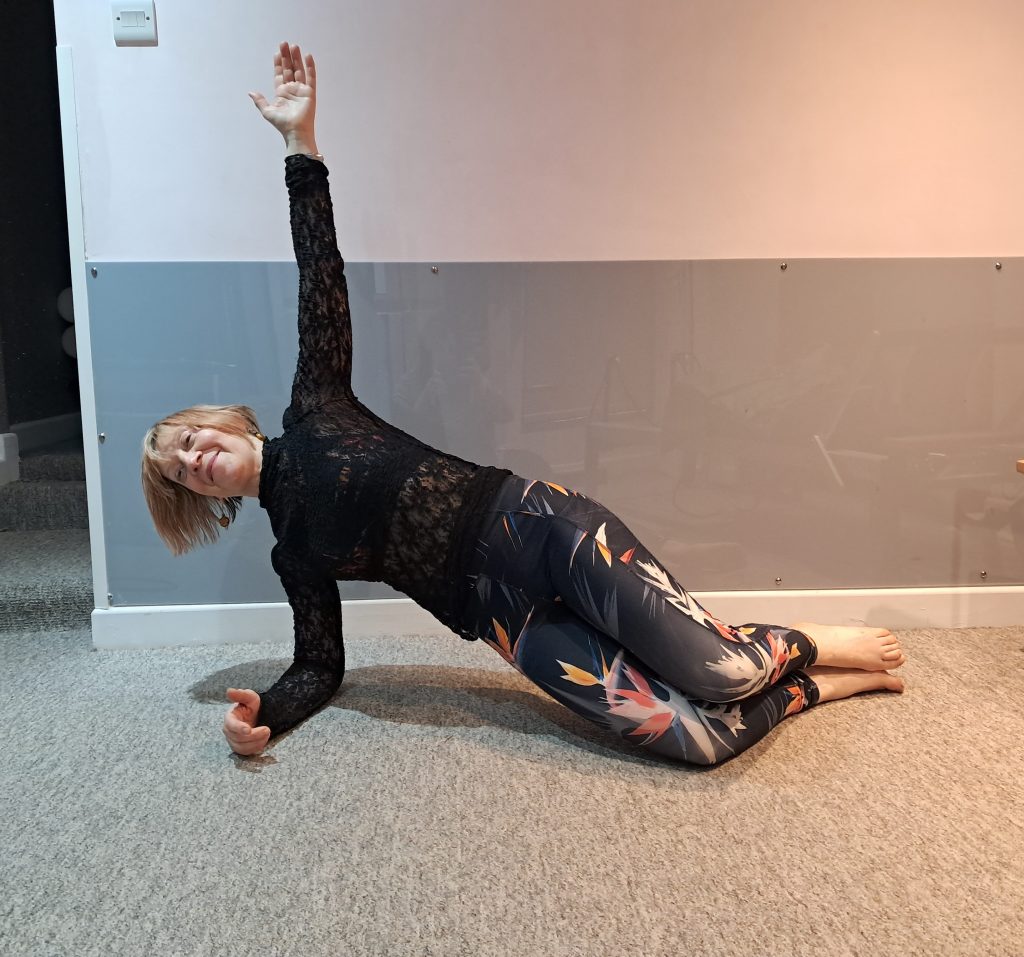
Side Plank, (pictured below) opens up a whole other type of strength where the body is on an angle and so the load distribution is unequal. This is excellent spine strength training, providing you do both sides.
This is not an exhaustive list. You could argue for loads of other exercises working the spine but its a good spread of examples.
Back Pain, other spine conditions and spine strength
I couldn’t really write this article without mentioning back pain.
There is whole parallel universe away from the idealised world of this article, where people have to live with and deal with, back injury, back pain, either on going, or as a one off serious episode.
I wanted to acknowledge that this is another difficulty and maybe a barrier for some people to be able to think clearly or positively about spine strength. The two things, pain and strength are not mutually exclusive though. Far from it, but if you have pain, then the approach needs to be gentle, careful and safe. It has to feel safe and be safe.
The same applies if you have arthritis, stenosis, scoliosis, or spondylosis. And that is just a few diagnoses. I know there are many more. Greater strength is still possible but needs a careful approach.
Conclusion
I hope that I have managed to convey that there are loads of ways to develop spine strength. The spine is perversely out of sight and out of mind. Something then happens, like a diagnosis of Osteopenia and suddenly it is in your mind but still out of sight, and crucially feels out of reach somehow. Luckily though, it turns out that it is within reach. It is completely ok to start gently but keep working away, consistently, safely and get that adaptation sorted!